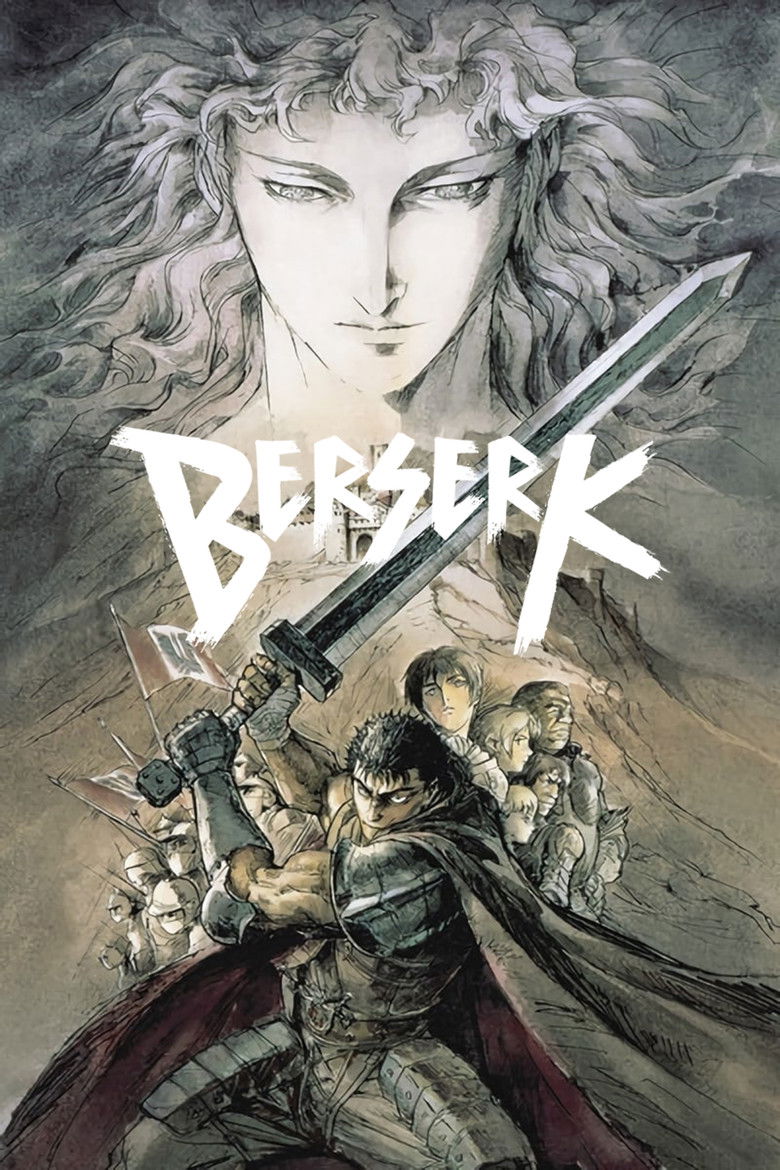
Berserk is a manga series that has been in publication, with interruptions, since 1989. Its author, Kentaro Miura, died in 2021 before completing it. The story continues, completed by members of his studio under the guidance of his closest collaborators, but the work that defines the series — the original thousand-plus pages that Miura drew — constitutes one of the most sustained artistic achievements in the medium’s history.
Recommending Berserk is complicated by the fact that its greatness is inseparable from its difficulty. This is a series that contains extended sequences of graphic violence, including content that some readers will find impossible to continue past. It asks a great deal of its audience. What it returns for that investment is commensurate.
The Pop Score
Rating based on impact and craft.
What Guts Is About
Guts — the protagonist, a man of enormous physical capability who has spent his entire life in war — is not a hero in any conventional sense. He is a person who has survived everything that should have destroyed him and who keeps moving forward not because he believes it will get better, but because stopping is not something he knows how to do.
This is the manga’s central question: what does it cost a human being to survive that much? What is left of a person after the world has done everything it can to eliminate them? Miura’s answer, arrived at across forty volumes of meticulous dark fantasy, is nuanced and uncomfortable and ultimately more humane than the premise suggests.
The Golden Age Arc
The series’ most celebrated sequence — the Golden Age arc — functions as both a prologue and the emotional foundation for everything that follows. It tells the story of Guts’s past, his time with the mercenary band called the Band of the Hawk, and his relationship with Griffith, the band’s charismatic leader.
The arc is a tragedy in the classical sense: it follows characters with real virtues to their ruin through the collision of those virtues with irreconcilable forces. Griffith’s ambition, Guts’s need for independence, the structural impossibility of the relationship between them — these are developed with a patience and complexity that most novels do not achieve. By the time the arc reaches its catastrophic conclusion, Miura has made you believe in every character involved, which is what makes what happens to them so destructive.
Miura’s Artwork
The technical standard of Miura’s illustration is the benchmark against which detailed manga artwork is measured. His architecture is historically researched and rendered with a precision that makes the medieval European fantasy setting feel inhabited. His battle sequences have spatial logic — you know where bodies are in relation to each other and what it costs them physically to be there. His grotesque imagery — the demons, the distorted flesh, the impossible anatomy of nightmare — is drawn with the same care he brings to a quiet scene of characters talking around a campfire.
This evenhandedness of attention is one of the series’ defining qualities. Miura does not reserve his craft for the spectacular moments. The quiet scenes earn the same level of care, which means that when violence arrives, it registers against a baseline of ordinary life rather than against a backdrop of constant spectacle.
Casca and the Manga’s Emotional Core
The manga’s other protagonist — Casca, the only female member of the Band of the Hawk’s inner circle — is central to understanding what Berserk is actually about. Her arc is one of the most painful and controversial in the medium, and its handling requires the kind of trust that the series earns slowly, through hundreds of pages of establishing who she is before anything is taken from her.
The series’ long middle section — years of publication — is structured around the question of whether Casca can be restored to herself. This is a different kind of heroic quest from the ones fantasy usually offers. It is a quest for a person’s own mind, their own memory, their own capacity to be present in their own life.
On Moving Forward Regardless
The title is the series’ thesis. Berserk — going berserk — describes a state of combat frenzy, of action uncoupled from rational calculation, of the body doing what it has been trained to do in the absence of any other resource. Guts spends the entire series in a version of this state. He is always moving forward. He rarely knows where he is going.
What the series is about, underneath all the violence and mythology, is whether this kind of persistence has meaning. Whether surviving is itself an achievement. The manga’s answer, insofar as Miura was able to provide one before his death, is tentatively yes — and the tentativeness is honest.
Berserk. Original manga by Kentaro Miura. Serialized in Young Animal since 1989. Continued after Miura’s death by Studio Gaga. This review reflects the personal opinion of the author.


コメント