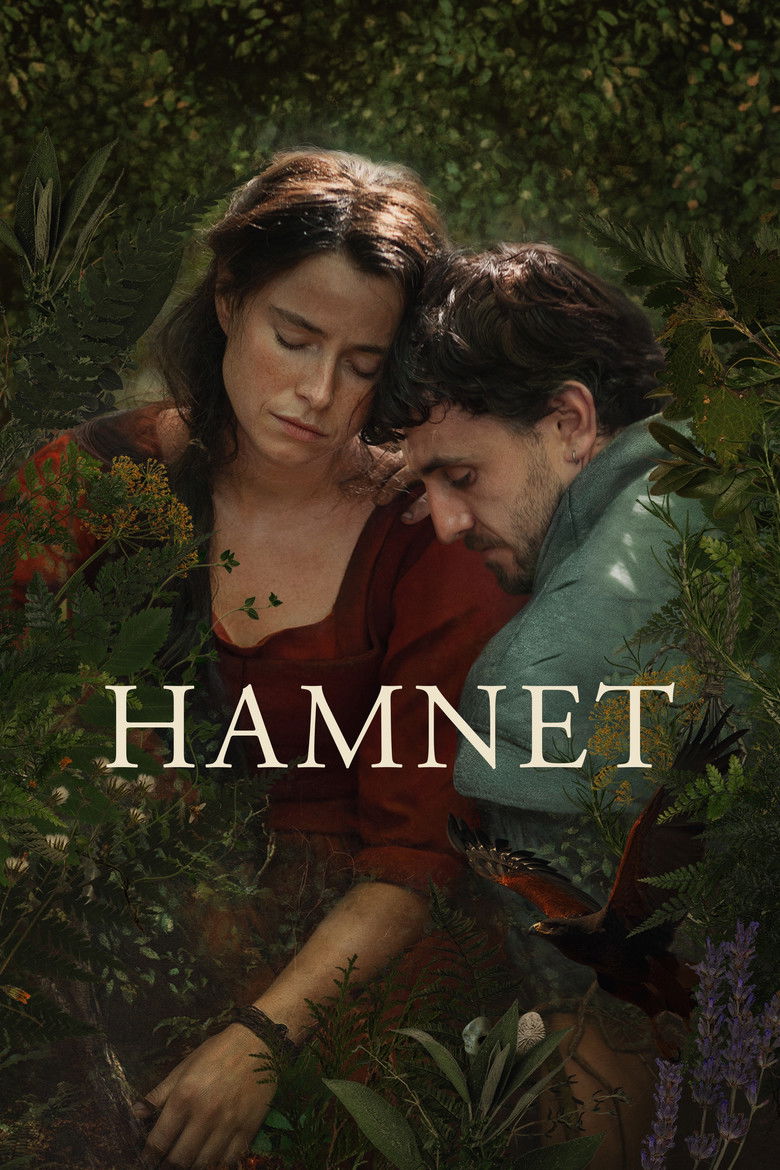
Hamnet opens with a woman mixing herbs in a cottage garden, her hands moving with the assurance of someone who has spent years learning what things are for. Agnes — called Anne in most tellings of the historical record, but given back her own name here — is presented first as a person with knowledge, with competence, with a specific relationship to the natural world. Only after we have seen who she is does the film show us what is about to happen to her.
The film is Chloé Zhao’s adaptation of Maggie O’Farrell’s 2020 novel, which imagined the life of Agnes Hathaway — the wife of William Shakespeare — around the death of their son Hamnet in 1596. The novel was celebrated for exactly what it does: it takes a woman who exists in historical records primarily as a footnote to someone else’s fame and insists on her full interiority. The film inherits this project and carries it forward with extraordinary fidelity to its spirit.
The Pop Score
Rating based on impact and craft.
Jessie Buckley’s Agnes
Jessie Buckley has been building a body of work defined by a particular quality: the ability to play women in extremis without sentimentality. She does not soft-pedal the difficult parts of her characters or find ways to make them easier to watch. In Hamnet, she plays grief as a full-body experience — something that moves through Agnes the way illness moves through a body, affecting her gait, her voice, her ability to look at the things she loves without being ambushed by what she has lost.
But Buckley also plays Agnes’s strength with the same fidelity. Agnes is not primarily defined by her grief. She is defined by her understanding — of plants, of people, of the invisible forces that move through the world. The film’s opening establishes this before anything else. By the time the grief arrives, you know who it is happening to, and that knowledge makes all the difference.
Paul Mescal’s Will
Will Shakespeare — never referred to by the name he would become — is played by Paul Mescal as a young man in the process of discovering something about himself that he cannot yet fully articulate. He is restless in the way of someone who contains more than their circumstances can hold. He loves Agnes. He leaves. These two facts coexist in the film without simple reconciliation.
Mescal is careful not to make Will sympathetic at the expense of honesty. The man who will eventually transform his family’s grief into Hamlet is shown here before that transformation — still inside the grief, not yet at the distance necessary to make art from it. The film does not forgive him for leaving. It does not condemn him either. It simply holds both things at once.
On the Central Subject: To Be the One Who Stayed
The film’s deepest subject is not grief, though it is rigorously attentive to grief. Its deepest subject is what it means to be the person in a marriage who stayed — who managed the household, raised the children, remained rooted in a place while the other person went away to become famous.
Agnes’s knowledge — her herbalism, her capacity to read people — is not valued by the London theatrical world that will make her husband immortal. She is not present at the Globe. She does not appear in any surviving accounts of the plays. She exists in the historical record as a name, a dowry dispute, and a controversial bequest in a will. The film insists that her absence from the record is not the same as her absence from the story.
Hamnet’s Death as the Film’s Emotional Center
The death of the Shakespeares’ son Hamnet, at age eleven, is the film’s central event. The scene is handled with restraint that makes it more devastating than spectacle would. Agnes holds her son. The film does not look away, but it also does not linger. It trusts that the audience has been paying enough attention to feel what it needs to feel without being told how to feel it.
What follows — the grief, Agnes’s fury, the eventual transformation of that grief into the play — is the film’s second movement. O’Farrell’s novel ended with Agnes watching Hamlet performed and recognizing her son in it, finding something like consolation in the act of witnessing. Zhao’s film preserves this moment and shoots it with a stillness that is the right formal response to what it contains.
On What the Film Asks of Viewers
Hamnet is a slow film. It takes its time with Agnes’s daily life in Stratford in ways that require patience from an audience accustomed to drama being compressed. This pacing is not a flaw. It is the film’s argument: that the texture of an ordinary life — the herbs, the weather, the children, the market — has the same claim on our attention as the extraordinary events that punctuate it.
The film trusts that the audience will find Agnes interesting enough to spend time with without constant dramatic incident. For the right viewer, this trust is completely justified.
Hamnet (2025). Director: Chloé Zhao. Starring: Jessie Buckley, Paul Mescal. This review reflects the personal opinion of the author.


コメント