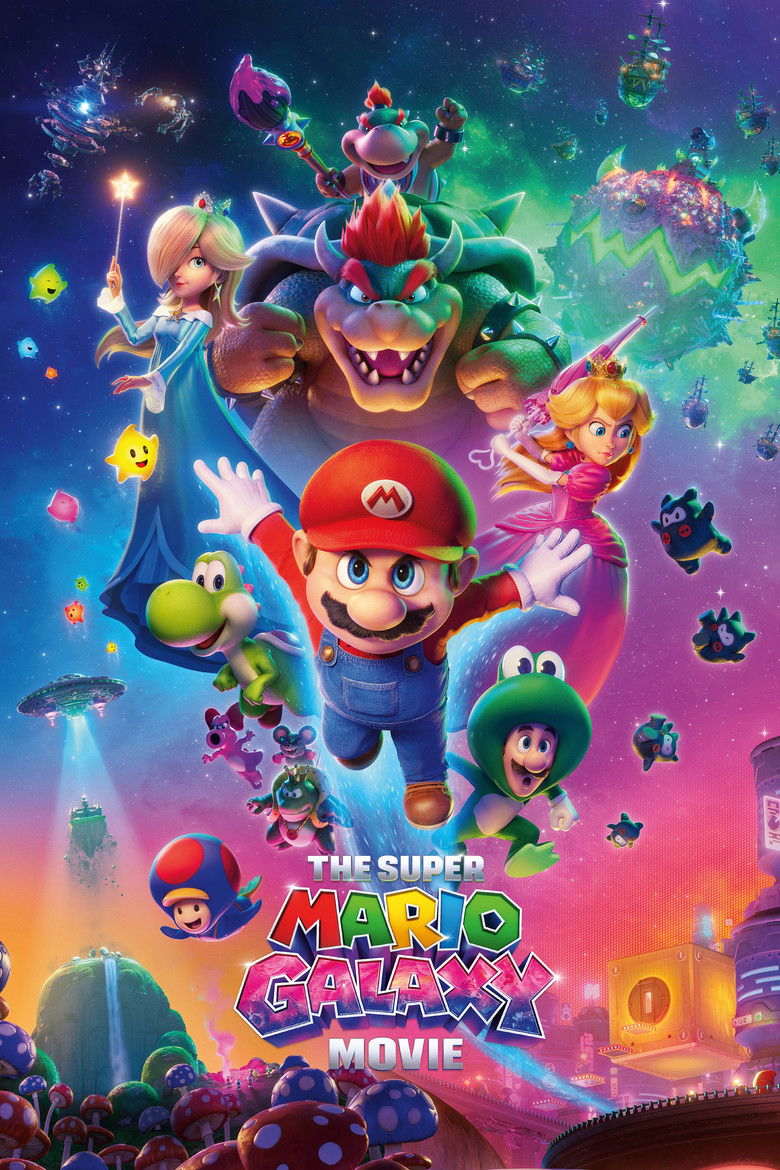
The Super Mario Galaxy Movie is, formally speaking, a sequel to the 2023 animated film — the same character design language, the same rendering approach, the same willingness to bring the games’ visual logic into three-dimensional space. What it does differently, and more ambitiously, is engage with the specific qualities of the Galaxy games rather than treating Mario’s world as a generic adventure setting.
The Galaxy games — Super Mario Galaxy (2007) and its sequel (2010) — were defined by a single design insight: that gravity could be an axis of creativity. By placing Mario on small planetoids with their own gravitational fields, the games created spaces that were simultaneously intuitive (gravity always pulls toward the nearest surface) and constantly surprising (the nearest surface is often upside-down relative to where you started). The film inherits this insight and applies it narratively: its protagonist must repeatedly reorient himself relative to a world that refuses to stay in the expected configuration.
The Pop Score
Rating based on impact and craft.
What the Film Understands About the Source Material
Nintendo’s Mario games have always been more interested in spatial problem-solving than in character or narrative — in the joy of learning a space and moving through it with increasing fluency. The 2023 film largely bracketed this quality in favor of a conventional adventure story structure. The Galaxy Movie engages with it more directly: the film’s most successful sequences are ones where the pleasure of movement through unusual space is legible on screen.
There is a sequence set in a gravity-inverted region where Mario and his companions are navigating a space that operates by different physical rules than the one they started in. The sequence is constructed so that the spatial logic is followable — you can track where each character is in relation to the others and in relation to the various surfaces competing for their feet — and the pleasure of following it is the pleasure the games offer: the satisfaction of spatial comprehension achieved.
On the Animation
The visual language draws from the games’ palette — the primary colors, the rounded forms, the specific warmth of the Galaxy aesthetic — while creating depth and texture that the interactive medium cannot achieve. The space sequences are genuinely beautiful, and they are beautiful in the right way: not as spectacle designed to impress, but as space designed to inhabit.
The film’s best-looking moments are its quietest — planetoid surfaces seen from a distance, the texture of cosmic dust, the specific quality of light in a region of the universe that is not governed by familiar physics. These moments are doing what the games did at their best: making you feel that there is something worth exploring in this world beyond the immediate objective.
Limitations and Achievements
The film’s narrative is its weakest element — a straightforward quest structure that does not match the spatial sophistication of its visual conception. The antagonist is adequate. The emotional beats are serviceable. The film would benefit from a screenplay with the same creative ambition as its art direction.
But as a demonstration of what animated adaptations of Nintendo properties can achieve when they take their source material’s formal qualities seriously rather than simply borrowing its characters, The Super Mario Galaxy Movie is a meaningful step forward. It knows what made the games special, and it finds ways to make those qualities visible in a different medium.
The Super Mario Galaxy Movie (2025). This review reflects the personal opinion of the author.
Official Trailer
この記事を書いた人
零(れい)
映画・アニメ・漫画を深く観るための考察ブログ FRAME ZERO の書き手。没入と批評の両立を目指している。感動すると素直に泣くし、演出の粗も気になる。最終的にはいつも人間に興味が行き着く。


コメント