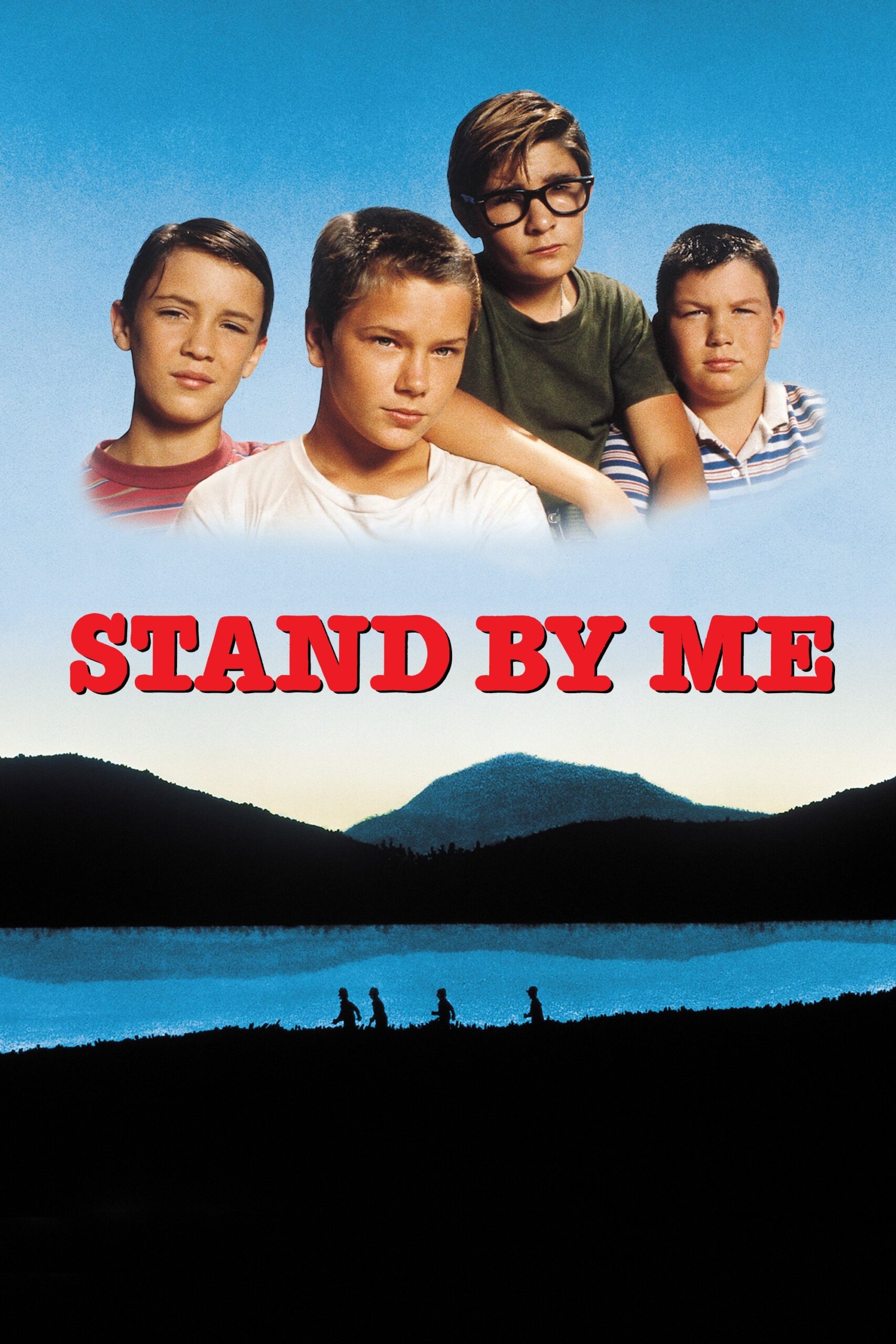
When I first watched Stand By Me as a child, what stayed with me was the smell of summer along the railroad tracks. Watching it again as an adult, I found something else flowing beneath that summer: four boys quietly navigating the American pressure to be strong, and ultimately stepping off it. A film more than thirty years old kept revealing a different face the longer I sat with it.
- VISION: 1959 Oregon, the Railroad, and the Camera’s Distance from Four Boys
- EXECUTION: Four Fathers, Four Wounds, Stacked as Independent Episodes
- RESONANCE: What Surfaced Beneath the Summer Nostalgia
- DEPTH (First Half): How Viewers Acquired the Resolution to See American Conformity
- DEPTH (Second Half): The Strength Myth Each Boy Carries, and the Quiet Refusal at the End
- IMPRESSION: What Stayed With Me a Few Days Later
- CLOSING: When to Walk the Tracks Again
- TEMPERATURE
VISION: 1959 Oregon, the Railroad, and the Camera’s Distance from Four Boys
Rob Reiner’s image-making in Stand By Me is more disciplined than I remembered. For a 1986 production, the color palette is remarkably muted. The Oregon countryside at midday, the dust and grass beside the railroad bed, the gravel between the ties, all sit in a desaturated register. The only elements that hold strong color are the four boys’ clothing and the occasional glimpse of a passing train. Everything else is held in dulled greens and grays, as if the film were a faded family photograph rendered moving.
The Pop Score
Rating based on impact and craft.
In my art school years I once copied a section of Andrew Wyeth’s Christina’s World. What struck me was that the vast field which dominates the canvas is never bright green; it is a sun-bleached earth color, slightly yellowed, slightly tired. The eye is drawn to the figure in the foreground, but the weight of the dulled field carries the painting’s nostalgia. Reiner’s cinematography here operates on a similar logic. By lowering the saturation of the surrounding world, he allows the four boys to register not as “present” but as “image of memory.” For a story told in retrospect by an adult narrator, no other color design would have been more honest.
The camera placement is just as considered. Reiner often films the four boys in profile, from a moderate distance, framing them from their feet up to their chests. Above them lies a wide blank sky; beneath them, the gravel of the rail bed. A measured distance is maintained between viewer and boys, neither too intimate nor too remote. That spacing reads, in retrospect, as the precise emotional position of the adult narrator. The boys are already creatures of memory; the frame keeps signaling the unrecoverable distance between then and now. The image refuses immersion. It insists on observation, and that observational gentleness is, paradoxically, what allows the film’s grief to surface.
EXECUTION: Four Fathers, Four Wounds, Stacked as Independent Episodes
Looked at structurally, the screenplay is a body-hunt adventure on the outside and a quartet of inherited wounds on the inside. Gordie is the surviving son whose father has effectively erased him after the death of his older brother, declaring him empty. Chris is the bright boy from the town’s worst family, prejudged by teachers and townspeople as the next bad seed. Teddy worships a father who supposedly stormed the beach at Normandy but is in fact institutionalized and once held Teddy’s ear to a wood stove. Vern is a younger brother trained to imitate, never to think.
What is striking is how these wounds are introduced as discrete vignettes while pointing at a single underlying theme. All four boys are required, in different dialects, to perform a version of American boyhood: be strong like your brother, like your father, like the older boys, like the men at the diner. Stand straight. Don’t cry. Don’t back down. Their decision to walk the railroad is, on this level, a temporary stepping-out of that requirement. The railroad is the artery connecting town to town, and Reiner repeatedly grants their walking sequences enough screen time to let the act of stepping out become felt time. The film treats their walk not as transit but as ritual.
The climax is engineered with care. After the body is found, Ace and his older gang appear, claiming the corpse and the hero status. Gordie produces his father’s pistol and raises it at Ace, trembling but unwavering. A twelve-year-old aiming a rifle at an older man is, in iconographic terms, a direct quotation of the American Western standoff, and as such it is the maximal performance of the strong-boy demand. Yet within minutes of Ace’s retreat, the four boys decide not to take the body. They report Ray Brower anonymously to the police, refusing the heroic homecoming the entire trip had been arranged to secure. The script holds these two beats next to each other on purpose: the boy who can fully shoulder the strength code, only then earns the right to step off it. The film does not preach the lesson. It simply lets the editing place those two actions side by side and trusts the audience to read the silence between them.
RESONANCE: What Surfaced Beneath the Summer Nostalgia
I should be honest. Before this re-viewing, my memory of Stand By Me was almost entirely a memory of summer. Ben E. King’s theme song, the railroad, four backs walking in single file. The film lived in my head as the cinematic equivalent of an early-adolescent nostalgia. I think I first saw it on television, in the living room, alongside my mother. What I took from it then were only the adventure beats: the leech sequence, the fleeing-from-the-train bridge scene, the campfire at night where a distant gunshot terrifies them. Each of them slotted neatly into the children’s-adventure shelf in my memory. Even the death of the boy was processed, at that age, as the engine of the adventure rather than as a death.
What rose to the surface this time was different. Gordie’s quiet line, “my father hates me,” landed with a temperature I had not registered before. Chris’s monologue in the woods, where he calmly describes his belief that he will never climb out of his family’s reputation, hit me harder than any of the adventure set pieces. A twelve-year-old, articulating his own foreclosure as cleanly as that, is a different kind of horror than the leech or the train. As a child, those scenes registered as “the slightly dark parts in between the fun.” Now they are the center. The leech and the train, by contrast, retreated to the periphery, as if the film had quietly rearranged its own emphasis while my back was turned.
So what changed? The film, of course, has not. What changed is my own resolution. The shapes Stephen King wrote and Reiner protected have always been there; my eyes have caught up to them. The summer haze is still on the screen, but now there is a second sound underneath it, and the second sound is what I find myself listening to. This re-viewing does not feel like “the film I remembered, only better.” It feels like the ground of my memory cracking, and a different geological layer being revealed underneath. There is a particular kind of dizziness that comes from discovering that you have been carrying a film around for decades and never really watched it; that dizziness, more than the leech or the train, is what made this re-viewing memorable. It is the dizziness of catching one’s own past as a slightly less attentive viewer, and forgiving them, and also waving goodbye to them.
DEPTH (First Half): How Viewers Acquired the Resolution to See American Conformity
When Stand By Me opened in 1986, audiences outside the United States largely received it as a film about an American summer. The railroad, the river, the woods, the train, the gun, the heroism: these were already icons of American boyhood, and we consumed them with a certain exoticism. The pleasure of the adventure, the warmth of the friendship, the nostalgia of the soundtrack. That was as far as the film traveled for many of us. The layer beneath, the layer of imperatives about who an American boy must be, was simply not visible to those of us watching from outside. At least it was not visible to me.
The resolution to see that layer is, I think, something we have collectively acquired over the past decade and a half, largely through the internet. The sheer volume of American discourse that now arrives in our daily feeds has gradually mapped the country’s conformity pressures for us. Debates around social movements, identity politics, masculinity, and patriotism, along with the secondary discourses that push back against each of those, have made visible the dense weave of “ought” that runs through American social life. Even the smallest cultural markers, the way a tote bag, a haircut, a favored bookstore can be coded as identity, are now part of an observable grammar. Once a viewer has seen that grammar, the simple proposition “America is the land of freedom” can no longer be held without footnotes.
This is not a political position. I take no stance on the merits of any particular American movement, in any direction. What has changed is purely a matter of resolution. The shape of the pressure grid that runs across American social life has become visible from outside, in a way that it was not in 1986. And that newly resolved eye, returning to the 1986 film, finally registers the current that was always flowing beneath the surface. The weight of the boys’ inherited imperatives, the steady “be strong, don’t back down, don’t cry,” is now a weight one can see being carried. I can no longer extract only the adventure pleasures from the film. The other layer is right there, and it refuses to be unseen.
DEPTH (Second Half): The Strength Myth Each Boy Carries, and the Quiet Refusal at the End
Returning to the inside of the film with that eye, each boy’s wound reveals itself as a distinct facet of the same strength myth. Gordie’s father, who weighs his surviving son against his dead older brother and finds him empty, is a domestic miniature of American masculinity. To “have something inside” is, in that father’s grammar, to be strong, straight, brave, useful. Gordie’s writing is not even acknowledged as a possible answer; storytelling is silently filed under what empty boys do to compensate.
Chris’s quiet declaration that he will never climb out is a portrait of how a small town’s reputational labels can foreclose individual futures. He is intelligent and unusually perceptive, but every flash of those qualities is canceled in advance by the sentence “Chris Chambers is a Chambers, of course.” The scene in which he breaks in the woods is one of the most fragile pieces of acting in 1980s American cinema, and Reiner protects its fragility by simply holding the two faces still. The directorial humility is what makes the moment land. A boy who has been required to be strong steps down for thirty seconds, and the film does not score that descent. It just lets it occur.
Teddy’s worship of his Normandy-veteran father is a dependence on myth itself. The actual father is institutionalized and once branded his son’s ear. But Teddy has nothing to set against the loss of the myth, so he keeps the myth alive in the air around him, even at the cost of his own coherence. When the junk man insults his father, Teddy’s rage is not the rage of someone defending the truth; it is the rage of someone bracing a collapsing scaffold. Strength as myth, once accepted, is hard to put down even when its underlying material is gone. The scene where his glasses fog with tears while he keeps protesting is something I could only fully receive in my late twenties.
And the very motive of the journey, “let’s find the body and become heroes,” is already an application form for the strength myth. The boys imagine returning to town as discoverers, named in the newspaper, validated as men. When Gordie raises the pistol at Ace, he is, in that instant, fully performing what the code asks. Then, minutes later, the four of them choose to phone in Ray Brower’s location anonymously, refusing the homecoming the trip was built to earn. They step off the validation loop and reposition themselves on the side of the dead boy’s dignity. It is a very quiet act of refusal. The film places it precisely where adventure films usually place their triumph, and that placement is the whole argument. Beneath the surface of an American boys’ adventure, Reiner and King were betting on a small refusal of the very code that drove the adventure in the first place.
IMPRESSION: What Stayed With Me a Few Days Later
A day after this viewing, what remained in my head was not the loud scene. Not the standoff with Ace, not the suspended seconds on the railway bridge, not the leech panic. What stayed with me was the quiet stretch at the end, the morning after Ray Brower is found, when the four boys walk back toward town. Almost no dialogue. A slow, almost ceremonial walk along the tracks. The end of the adventure, and at the same time the end of their childhood, plays out in those few minutes with very little spoken. Ben E. King’s theme, famous to the point of being unhearable in normal listening, returns at that moment, and on this re-viewing it played in my ear less like a friendship anthem than like a small theme for boys who refused to be heroes. It was almost a different song.
The other thing that stayed was the adult Gordie’s typed sentence, the one his narration enters near the end: that Chris became a lawyer, was killed breaking up a fight in a fast-food restaurant, stabbed by a stranger. As a child I cried at this line because of its sadness; as an adult I find a sharper bitterness folded inside it. Chris did climb out. He left his family’s reputation behind, became educated, became a man who placed himself on the side of others. But the very habit of stepping into a fight, that residual strength impulse, killed him. The boy who once stepped off the validation loop could not entirely step off it for life. There is no mercy in this footnote, and yet there is no contempt in it either. The film simply records that the descent from the strength myth is not a one-time act; it has to be performed again and again, and that some performances cost everything.
What remained, finally, was a set of distances. The distance between the four boys and the watching me. The distance between the boyhood I once had and the woman now watching. The distance between 1986 and the resolution we have built by 2026. Few films hold so many overlapping distances at once. That is why this film is unusually strong on re-viewing. The distances shift with every new viewing, and as they shift, new geological layers come up. King’s source story is durable precisely because it allows itself to be re-read across decades without resisting the reader’s new resolution.
CLOSING: When to Walk the Tracks Again
If you are considering a re-viewing of Stand By Me, my one suggestion would be to set aside, temporarily, the memory of it as a children’s adventure. Bracing for the leech scene, smiling in anticipation of the campfire songs, none of that is wrong. But beneath that braced anticipation, try listening for a different register. The temperature-low moments, when one of the boys says something almost off-handedly about his father, about his future, about his own worth. Lean toward those. The railroad theme is, on this listening, not a marching tune for heroes; it has always been a small elegy for the boys who chose not to be heroes.
I would especially recommend it to two audiences. The first is anyone who is starting to notice that they have spent years performing the version of themselves their family or community required, and who is just beginning to wonder what stepping off that performance would feel like. Gordie’s and Chris’s wounds are not exclusively American; they are the universal grammar of any community that binds individuals through reputation and assigned role. Watching the four boys discover, even briefly, that stepping off is possible can be a quiet permission. The second is anyone who has grown somewhat tired of the relentless American discourse of recent years and is wondering whether there is still something worth receiving from American cinema. This 1986 film already touched, with an unhurried hand, the very theme that current arguments orbit. Older work often reaches further than current debate. Discovering that is a particular pleasure.
I would watch it alone, on the cooler end of a summer evening. It is not the kind of film one wants to discuss immediately after the credits. The sound of gravel under the boys’ feet, the slow distance of their backs, the theme song one more time as the credits roll, all need a stretch of silence in which to settle. Reserve an evening in which silence is available, and walk the tracks again. The film does its best work when nothing follows it.
TEMPERATURE
◎ enthusiastic, with a strong re-viewing correction folded into the rating. My expectation going in was the nostalgia of a summer adventure film, and that layer is still on the screen, intact. The leech sequence, the train on the bridge, the campfire scenes all still function as the load-bearing beats of children’s adventure cinema. But beneath those beats, after thirty-some years, I found a second story I had never registered: the story of four boys quietly stepping off the American pressure to be strong. The gap between expectation and reality, rather than pulling the rating down, pushed it upward, because the gap is itself a function of my own resolution improving with time.
To watch a film I have known since childhood and find that it has, in fact, been carrying a question I now need, is a rare experience. That the screen of 1986 already contained this layer is, in itself, what I want to honor here. Stephen King’s reach as a writer, and Rob Reiner’s care in protecting that reach on screen, both deserve a renewed measure of respect. The film does not merely exceed expectation; it outlives the lifespan of its original expectation and continues to return something to the viewer who has aged. Re-viewing temperature, in cases like this, should be answered with enthusiasm rather than caution.
この記事を書いた人
零(れい)
映画・アニメ・漫画を深く観るための考察ブログ FRAME ZERO の書き手。没入と批評の両立を目指している。感動すると素直に泣くし、演出の粗も気になる。最終的にはいつも人間に興味が行き着く。

コメント