VISION — Tatara Soot and Forest Humidity, Now Revealed
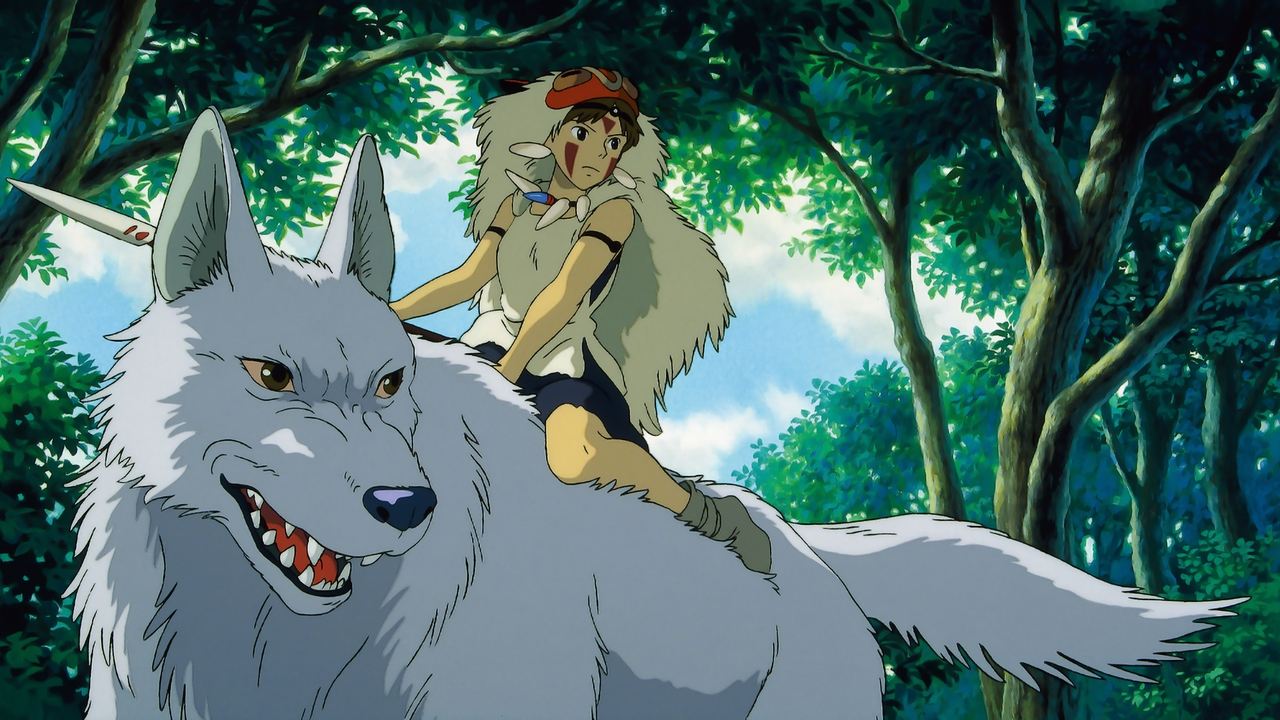
Princess Mononoke returned to Japanese theaters in spring 2026 in a 4K remastered presentation. It has been roughly thirty years since its 1997 release. I first saw it as an elementary school student on a television broadcast. I have rewatched it many times since. Watching it for the first time on a 4K theatrical screen was an unexpected reset. By the opening scene of the boar god corrupted into a Tatari demon, I had already sunk into my seat. I had not anticipated that twenty-nine-year-old animation could feel this current.
The single largest discovery of the 4K version is the density of information held in the frame. In the Iron Town sequences — the women under Lady Eboshi forging iron — the gleam on the metal, the sweat on their hands, the suspended particles of soot, are all preserved on screen. Details I never registered in the 1997 first viewing are visible now at higher resolution. The aging of the source material works in reverse: long-dormant information inside the cels is reactivated.
The Pop Score
Rating based on impact and craft.
The humidity of the Forest Spirit’s woods is also fully transmitted only in 4K. The overlap of leaves, the micro-irregularities of moss surfaces, the transparency of water droplets — all of these now interlock as a single atmospheric register. From my own art-school experience painting landscapes, I understand how difficult “painting air” actually is. Miyazaki and the animation team painted leaves and moss and water in order to paint air. The remaster confirms how right that decision was.
EXECUTION — Why 1997 Direction Has Not Aged
The film’s direction has not aged because Miyazaki had both a high density of motion when motion was needed and the discipline to suspend motion when it wasn’t. Ashitaka’s village departure, combat at Iron Town, the falling head of the Forest Spirit — each operates at a different motion register. The strict discrimination between scenes that speak through motion and scenes that speak through stillness organizes cinematic time with unusual force. This level of control remains rare in contemporary feature animation.
Editing rhythm is similarly distinctive. The film runs two hours and fourteen minutes but does not feel long. Cut timing, the alternation between flashback and present, the parallel and divergent paths of San and Ashitaka — these are edited according to psychological rather than physical time. The audience experiences the film by emotional duration. For a long feature this is the ideal editing decision.
Returning to the voice cast in 2026 makes the original casting choices visible as a turning point. Yoji Matsuda as Ashitaka, Yuriko Ishida as San, Yuko Tanaka as Eboshi, Kaoru Kobayashi as Jiko-bo — all primarily theater and live-action actors, deployed as voice actors. Their delivery departs from the standard voice-acting register and brings a more theatrical, more bodily quality to the soundtrack. This casting strategy became a meaningful inflection in the lineage of voice direction in Japanese animation.
RESONANCE — How Close the 1997 Question Sounds in 2026
What I felt most strongly walking out of the 4K presentation was how near the film’s question still is. In 1997 the work was widely framed as an opposition between nature and humanity. From 2026, that framing reads as inadequate. Eboshi’s Iron Town is also a refuge for people with leprosy, a place where women survive by forging iron, and a community of the socially excluded. Her war is not simple environmental destruction; it is a survival strategy of those pushed to the periphery of feudal society.
Reading the film through the lens of 2026 — environmental crisis, gender, the question of where excluded populations live, the politics of industrial transition — Miyazaki had folded all of these into the frame twenty-nine years ago. He refused the easy nature-versus-humans binary. Eboshi is not a villain. Ashitaka is not a justice-bearer. San is monstrous and more humane than anyone else in the film. This complexity is the deepest reason the work has not aged.
What affected me most was the final scene’s parting between Ashitaka and San. “You will live in the forest, and I in Iron Town. Let us live, together but apart.” I have heard that line many times. On the 4K screen, Ashitaka’s eyes carried something I had not previously been able to read: simultaneous acceptance of the impossibility of cohabitation and a determination to remain connected anyway. As an elementary school viewer I could not register that. In my late twenties, watching it now, the weight of the moment finally lands.
DEPTH — The “Re-Evaluation” Frame as a Critical Approach
This article reads Princess Mononoke through the angle of “re-evaluation” — the practice of returning to past works with a later vantage in order to discover structures that the first viewing could not reach. The film is a particularly rich object for this practice because Miyazaki was working half a step ahead of his moment, and the full range of the 1997 questions becomes visible only with thirty years of subsequent context.
Another axis of re-evaluation is visual durability. Whether 1997 animation can stand on a 2026 4K screen is both a technical and an aesthetic question. The film passes both. The detail density of hand-drawn animation provides a baseline already capable of meeting digital resolution gains. This is a kind of durability that contemporary CG animation has not, in my view, fully achieved.
IMPRESSION — What 4K Updated
What the 4K experience confirmed for me is that Princess Mononoke is a work that returns a different question with each viewing. The film I saw as an elementary school child, the film I saw as a high school student, the film I saw in my early twenties, and the film I have just seen on a 4K screen in my late twenties are not the same film. The work has not changed. I have. Different strata in the work become visible as I become someone capable of seeing them.
A short list of works behave this way: Nausicaä of the Valley of the Wind, Blade Runner, 2001: A Space Odyssey. Princess Mononoke belongs unambiguously on that list. Such works function as recurring conversation partners across a life. The 4K remaster offered a new occasion for that recurrence inside a theater rather than at home.
CLOSING — How and to Whom to Recommend
Recommending the film to anyone who hasn’t seen it is obvious. The stronger recommendation is to those who have already watched it many times: see this in 4K in a cinema. The work that runs on a domestic television transforms on the theatrical screen. Anyone in their twenties or older, with accumulated lived experience, will encounter strata they did not previously notice. Eboshi’s voice may produce tears that did not previously surface; Ashitaka’s eyes in the final scene may finally land at full weight.
TEMPERATURE — Rating
BLAZING
Score: 96/100 (with re-evaluation)
A rare experience in which the 1997 animation density fully reactivates on a 4K screen. The questions Miyazaki folded into the frame thirty years ago — environment, gender, exclusion, industrial transition — re-emerge legibly under a 2026 viewpoint. Visually durable and intellectually long-reaching, fully deserving of re-evaluation.
この記事を書いた人
零(れい)
映画・アニメ・漫画を深く観るための考察ブログ FRAME ZERO の書き手。没入と批評の両立を目指している。感動すると素直に泣くし、演出の粗も気になる。最終的にはいつも人間に興味が行き着く。
コメント