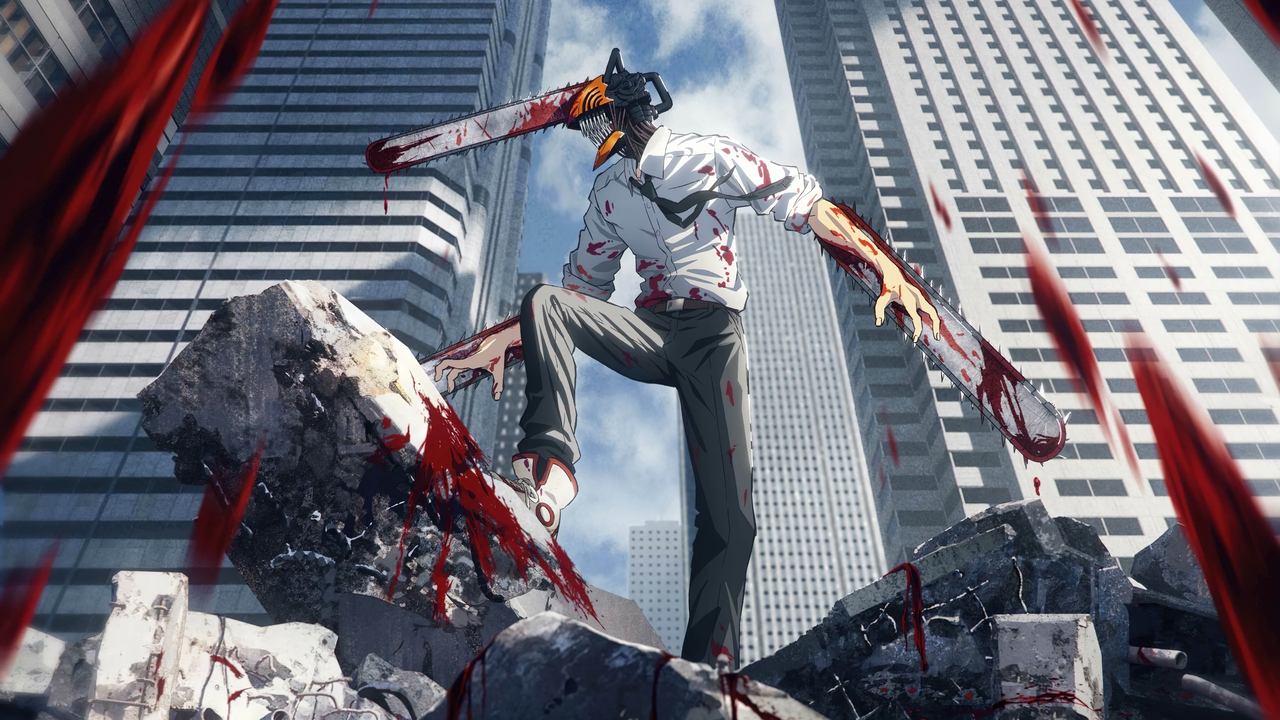
VISION — What “Jump+” as a Venue Was Saying
Chainsaw Man Part 2 is being serialized in Shonen Jump Plus, the digital sister magazine to the weekly print Jump that hosted Part 1. This shift in venue is itself a statement. After the fierce violence and emotional amplitude of Part 1, the unbridled centrality of Denji as protagonist, and the global scale of the fandom’s response, Tatsuki Fujimoto deliberately stepped Part 2 away from that heat. Moving from print to digital, replacing Denji with Asa Mitaka and Yoru the War Devil, and relocating the action to a school campus — these are not setting-changes. They are a redesign of the relationship between the work and its readership.
The visual language of Part 2 is distinct from Part 1. The panel rhythm is quieter, with more white space, more crossed glances, more sustained silence. If Part 1 was a manga in which something is constantly breaking, Part 2 is a manga set on the night before something breaks. Asa’s classroom desk, the road to school, the after-school street — these get drawn over and over, and the fragility of her ordinary life sits at the back of every page.
The Pop Score
Rating based on impact and craft.
In an art-school manga analysis class I once heard Fujimoto’s drawing described as “narration through line.” In Part 2 the line has thinned and become more hesitant. Part 1’s thick, raw line — especially the kinetic energy of Denji’s combat — has receded; Part 2’s line is introspective. I read this as a deliberate authorial choice, not a regression in skill.
EXECUTION — The School Setting as Structural Decision
Choosing a school setting for Part 2 is a major structural decision. School manga is a dominant genre — well-suited to character mapping, the contrast between ordinary life and the extraordinary, and the slow accumulation of adolescent feeling. Fujimoto pulls those tools into the Chainsaw Man world to allow devils — transcendent entities — to share space with high-school routine. The closest comparison is Evangelion’s combination of school and apocalypse, but Fujimoto’s interpretation is more fragmentary; the through-line is harder to see.
Asa as a protagonist is rendered carefully. She suffers severe bullying and is then forced into cohabitation with Yoru, the War Devil. The internal dialogue between Asa and Yoru is the engine of the story. This is structurally inverse to Part 1’s outward kinetic structure around Denji. Readers spend long stretches inside Asa’s interior, and that interiority is comfortable for some readers and oppressive for others.
The cost is to story tempo. One of Part 1’s strengths was the unstoppable forward motion — pages turning themselves, the situation always tipping. Part 2 deliberately slows. The decision is intelligible as authorial intent. For readers who loved Part 1’s tempo, the slowdown lands as something lost rather than gained. I belong to that group of readers.
RESONANCE — What Denji’s Sidelining Means
While reading Part 2 I think repeatedly about Denji. As Part 1’s protagonist he was extraordinarily specific — beginning in poverty, contracting with a devil, climbing out of the social bottom, defining himself through unguarded desire for women and food, honest about his appetites to the end. Asa is constructed as Denji’s opposite: a school student inside conventional social space, struggling with friendships, occupying ordinary territory. But that ordinariness, as the chapters accumulate, increasingly feels like the reader being deprived of Denji’s extraordinariness.
Denji appears in Part 2. He is not the lead. He is pushed into the background, encountered through Asa’s narrative frame. This is a natural extension of where Fujimoto left Denji at the end of Part 1, but the way it asks readers to redirect their accumulated investment is uncomfortable. We wanted Denji’s continuation. Part 2 supplies it only in fragments.
Personally, what disappointed me most is that Asa-and-Denji as a relationship has not approached the emotional amplitude of Denji-and-Power or Denji-and-Makima from Part 1. The comparison may be unfair. But for a reader who remembers where Part 1 reached, the absence of comparable emotional reach lowers the temperature toward the colder end. The gap between expectation and result is the source of my reading.
DEPTH — An Author Distancing Himself From His Fans
What Part 2 emanates throughout is the sense that Fujimoto is consciously stepping away from fan expectation. Part 1’s success expanded enormously after the anime adaptation, and the fandom is now globally massive. From inside that situation, Fujimoto could write Part 2 either as “what fans want” or as “what I want to draw.” He chose the second. The school setting, the inward psychology, Denji’s de-centering — all of these are choices that diverge from what Part 1’s audience was waiting for.
It would be easy to criticize this. I want to offer the alternative reading. When an author succeeding commercially keeps following fan expectation, the work tends toward self-imitation. Fujimoto is consciously refusing that trap. The refusal is honest. But the same honesty makes the bridge between Part 1 and Part 2 hard for readers to cross emotionally. I respect the decision and I also won’t pretend I didn’t want Part 1’s continuation. Both are true at once. My temperature settles where those two truths intersect.
IMPRESSION — Re-Evaluation Possibilities at Completion
The reading of this work could change substantially at the moment Part 2 completes. The current sense of “divergence from expectation” might re-read as “intentional distance” once the destination is visible. Fujimoto writes with long-form structural awareness, and Part 1 famously inverted its early reading at its climax. Part 2 may carry a similar reversal in reserve.
I keep reading because I want to find out. I don’t need Part 2 to reproduce Part 1’s emotional palette. I want Part 2 to reach its own destination. At present it has not yet reached one I can register. That is the honest temperature.
CLOSING — Recommended For
Fans of Part 1 should enter Part 2 prepared. Reading it with Part 1’s expectations will produce reliable disappointment. Reading it as a separate work — a new direction by the same author — yields more. Anyone interested in the relationship between authorship and commercial pressure in manga will find this an interesting contemporary case. Whether you can stay inside Asa’s interior for long stretches will determine whether you finish the run.
TEMPERATURE — Rating
COLD
Score: 64/100 (mid-serialization)
For readers who came in carrying Part 1’s emotional amplitude and kinetic forward motion, Part 2’s introspective structure and reduced tempo produce a real gap. Fujimoto’s authorial decision is intelligible and deserves respect. But the gap between expectation and reality is what I have to record. There is room for re-evaluation at completion.
この記事を書いた人
零(れい)
映画・アニメ・漫画を深く観るための考察ブログ FRAME ZERO の書き手。没入と批評の両立を目指している。感動すると素直に泣くし、演出の粗も気になる。最終的にはいつも人間に興味が行き着く。


コメント