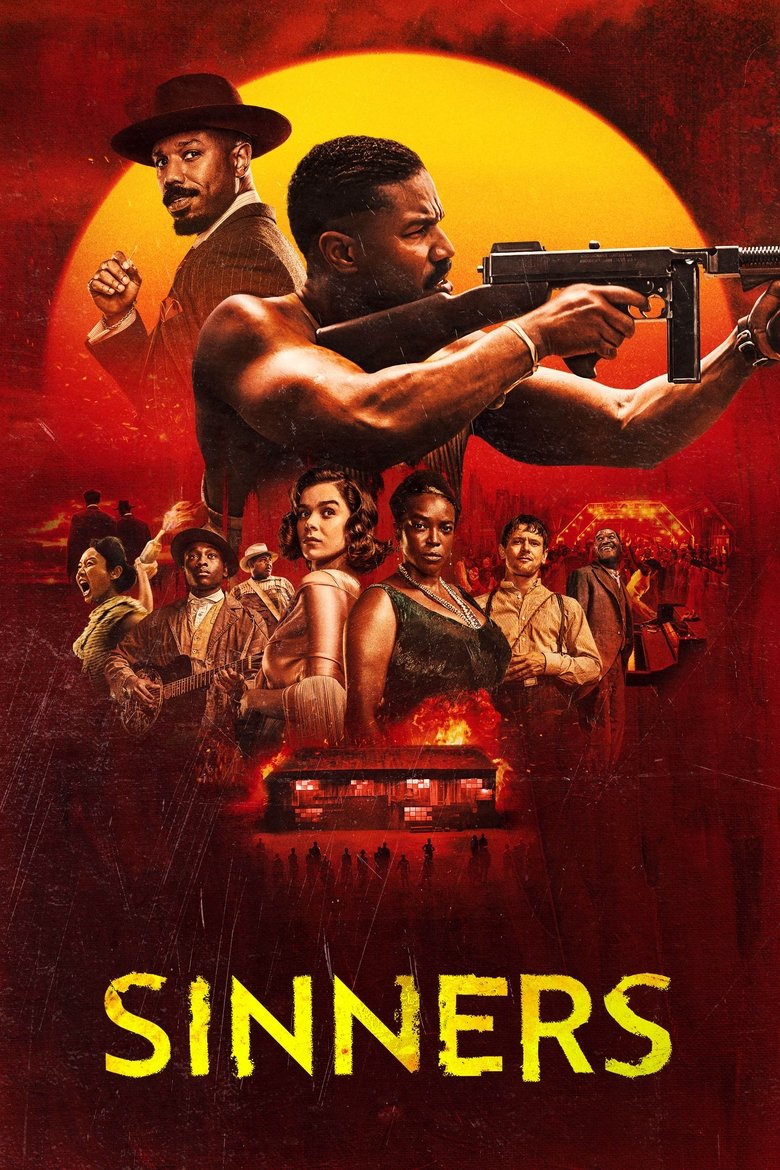
Sinners opens in the Mississippi Delta in 1932, and it announces its intentions in the first ten minutes: this is a film about music as survival, about the specific culture that Black Americans built in the most hostile possible conditions, and about what happens when something supernatural recognizes the power in that culture and wants to claim it. Ryan Coogler’s fourth feature is his most personal and his most formally ambitious. It is also the film that most clearly articulates what he has been building toward.
The premise: twin brothers Smoke and Stack (both played by Michael B. Jordan) return to their hometown after years away — years the film implies have involved things they are not discussing — with enough money to open a juke joint. The juke joint will be a place for the community, a place for music, a place that belongs to them. The night it opens, something arrives that has been drawn by what they are creating.
The Pop Score
Rating based on impact and craft.
Michael B. Jordan’s Dual Performance
Casting one actor as two twins risks becoming a stunt. Coogler refuses the stunt. Smoke and Stack are different people in ways that matter — in how they move, how they occupy silence, how they relate to the community they left and have now returned to. Jordan tracks these differences with consistency across the film’s full runtime. When the twins are in the same frame, you never lose track of which is which, not because of any visual trick but because Jordan has built two distinct people and inhabits them simultaneously.
The performance is also doing something more specific: it is showing two men who share an origin but have processed it differently. Stack carries his damage at the surface; Smoke has buried his deeper. The film is partly about what happens when those different coping strategies collide with something that can see through all of them.
Music as the Film’s Real Subject
The film’s emotional core is not the horror plot — which is constructed expertly — but the music. Coogler’s thesis, articulated through scene after scene, is that the blues was not merely an expression of suffering but a form of resistance and survival that required real courage. To sing about what you were living through, in the presence of people who recognized it, in a place that was yours — this was not entertainment. It was an act of communal self-creation.
The film makes you feel this. There is a sequence in the juke joint, before things turn, where the music builds and the dancing begins and the room becomes something — a space where the community exists fully, without apology or performance for an outside observer. Coogler’s camera holds on this. He understands that the audience needs to experience what the supernatural threat is threatening, not just be told about it.
The Horror as Extension of the Historical
The film is being marketed as horror, and there is genuine horror in it. But the threat is not arbitrary. It is connected — in ways the film is careful to make thematically coherent — to the same forces of exploitation, extraction, and erasure that structured the Delta’s history. The vampires, if that is what they are, want what has always been wanted from this community: its vitality, its creativity, its labor. What distinguishes them from the historical exploiters is only efficiency.
Coogler earns this reading. The film is not making a clumsy allegory — the supernatural is not a stand-in for something else. It is a mythological extension of something real, and the film treats it as such.
Official Trailer
On the Film’s Final Register
Sinners does not end happily, but it ends honestly. The community pays a price. What survives is not everything — but what survives is the music, and the memory, and the people who carry them forward. The final scenes have a weight that comes from everything the film has built: you know what was there, and you know what it cost, and you understand why it was worth defending.
Sinners (2025). Director: Ryan Coogler. Starring: Michael B. Jordan, Hailee Steinfeld, Delroy Lindo. This review reflects the personal opinion of the author.
この記事を書いた人
零(れい)
映画・アニメ・漫画を深く観るための考察ブログ FRAME ZERO の書き手。没入と批評の両立を目指している。感動すると素直に泣くし、演出の粗も気になる。最終的にはいつも人間に興味が行き着く。


コメント