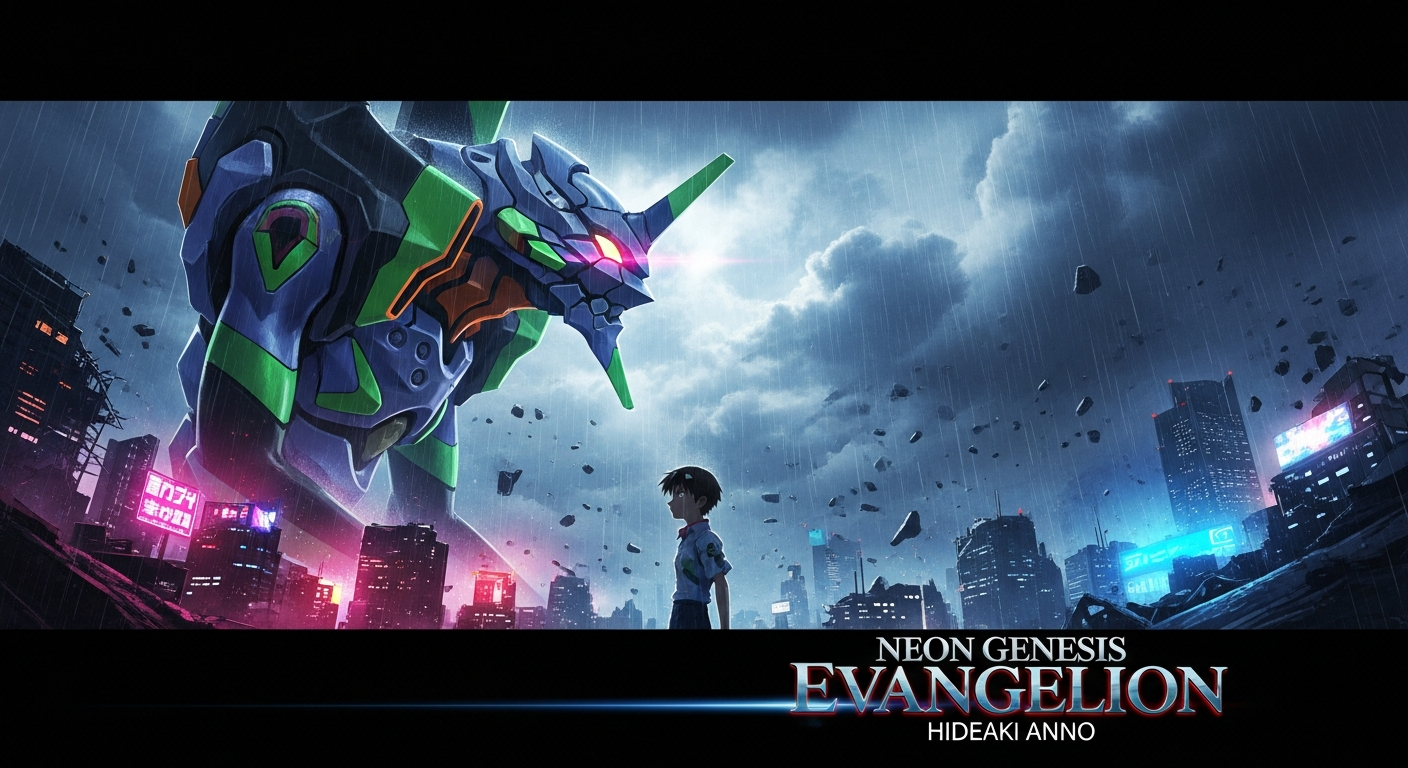
Neon Genesis Evangelion
Writing about Evangelion in 2026 means writing about a work that has been analyzed for thirty years by people who saw it when it mattered most — when they were fourteen, or twenty, or in the middle of their own depression. This verdict arrives late. That lateness, rather than being a disadvantage, may be the only honest position from which to write about a work whose meaning changes depending on when you encounter it. The value of the late perspective is the perspective itself: seeing Eva after the cultural noise has settled, after the Rebuilds have offered their revision, after Anno himself has said goodbye.
Watching Eva in 2026: the value of the late perspective itself.
/ 100
○
The vision of Neon Genesis Evangelion is, at its core, a betrayal of the genre it inhabits. Hideaki Anno constructed a mecha anime — the most commercially reliable format in the medium — and used it as a delivery system for a psychological study of depression, abandonment, and the terror of human connection. The giant robots are not the point. They never were. The Evas exist to get fourteen-year-olds into cockpits where the real violence can begin: the violence of being needed by people who cannot love you, of needing people who will not stay, of performing heroism while dissolving internally.
This vision was genuinely revolutionary in 1995. The mecha genre had, by that point, developed sophisticated variations — Tomino’s political mecha, Oshii’s philosophical mecha — but all of them maintained the fundamental contract that the machines mattered, that the battles were the narrative engine, that the pilots were vehicles for the audience’s power fantasy. Anno voided that contract. His pilots are broken. His battles generate not triumph but trauma. His machines are not tools but manifestations of parental horror — literal mothers, consumed and incorporated into the armor that their children ride into combat. The Freudian architecture is not subtext. It is the text, displayed with a frankness that the genre had never permitted.
The religious iconography — the crosses, the angels, the Dead Sea Scrolls, SEELE’s apocalyptic theology — has generated decades of interpretation that, viewed from 2026, largely misses the point. Anno has stated repeatedly that the Christian imagery was chosen for aesthetic reasons, not theological ones. The late perspective allows this claim to be taken seriously. The crosses that erupt from angel deaths are not symbols of salvation or sacrifice. They are images — powerful, alien, beautiful — deployed by a director with an extraordinary visual instinct and a willingness to use cultural symbols as raw material rather than as meaning-bearers. The vision is visual before it is intellectual, and the late perspective recognizes this without feeling cheated by it.
What the vision does carry, and what does not diminish with time, is the radical honesty of its psychological portraiture. Anno was clinically depressed during the production of Evangelion, and the series functions as a direct transmission of that condition in ways that more carefully constructed narratives about mental illness cannot replicate. This is not a work about depression. This is a work made by depression — shaped by its rhythms, colored by its distortions, structured by its logic. The vision’s power comes not from craft alone but from the authenticity of a creator who put his actual psychological state on screen and trusted the audience to recognize it.
The execution of Evangelion is split into at least three distinct registers, each operating at different levels of quality. The first twelve episodes constitute some of the finest mecha anime ever produced: tightly paced, visually inventive, with action sequences that deploy Gainax’s limited animation resources with extraordinary intelligence. The Ramiel battle — a geometric angel attacking with a particle beam, defeated through a cross-continental sniper shot — remains, thirty years later, one of the most perfectly composed action sequences in anime. The use of sound, of silence, of Sagisu Shiro’s score oscillating between orchestral grandeur and eerie minimality — the technical execution of these episodes is beyond reproach.
The middle episodes introduce the psychological register that would come to define the series. The shift is gradual — Shinji’s isolation deepens, Asuka’s facade cracks, Rei’s ontological status becomes increasingly disturbing — and Gainax executes this shift by progressively stripping away the genre scaffolding. Battle sequences become shorter, more brutal, less satisfying. The time between angel attacks stretches, filled with domestic scenes that carry the weight of unspoken suffering. The elevator scene in Episode 22 — Asuka and Rei standing in silence for nearly a full minute of screen time — is a master class in using the anime medium against its own tendencies toward visual density and narrative acceleration.
The final two episodes are where the execution discussion becomes contentious, and the late perspective offers a clarity that the 1996 audience could not have possessed. Episodes 25 and 26, produced under catastrophic budget and schedule constraints, abandon conventional narrative entirely in favor of a psychological deconstruction conducted through still frames, text cards, recycled animation, and direct address to the audience. Taken as television — as the final episodes of a story the audience had been following for six months — they are a failure of execution. Taken as an artistic response to creative crisis — the work of a depressed director whose resources have collapsed and who chooses to use that collapse as material — they achieve something that more polished conclusions could not. The roughness is not incompetence. It is the surface of a work that has stopped pretending it can separate its creator’s condition from its content.
The End of Evangelion, produced as the “proper” conclusion under restored budget conditions, is a different kind of execution entirely — cinematic, hallucinatory, technically astonishing, and emotionally annihilating. The Asuka battle in the film’s first half is the series’ action apex: a sequence of such visceral intensity that it retroactively justifies every complaint about the television ending’s limitations. The second half — Human Instrumentality rendered as a stream-of-consciousness fusion of live-action footage, abstract animation, and psychological confession — operates at a level of formal ambition that places it alongside experimental cinema rather than anime. The execution here is not clean. It is not balanced. It is overwhelming in a way that makes the concept of balanced execution seem beside the point.
The resonance of Evangelion is perhaps the most thoroughly documented in anime history, and the late perspective must resist simply rehearsing what has been said for three decades. What can be said freshly is this: the work resonates differently depending on when it finds you, and the version of Eva that a viewer encounters in 2026 is not the same work that devastated Japanese teenagers in 1996.
The 1996 audience encountered Eva as an active cultural event — a television series that began as a hit mecha show and progressively disintegrated into something unprecedented, generating a real-time collective experience of confusion, betrayal, and eventual recognition that has no precise parallel in anime history. That experience cannot be replicated. The 2026 viewer watches with full knowledge of the ending, the film, the Rebuilds, the critical apparatus, the cultural mythology. The surprise is gone. What remains is the emotional content, stripped of the context that originally amplified it.
And the emotional content holds. Shinji’s paralysis in the face of his father’s emotional inaccessibility resonates across cultural and generational contexts because the experience it depicts — the child who cannot reach the parent, who performs in order to be seen, who retreats when seen incorrectly — is universal enough to survive decontextualization. Asuka’s disintegration — the gifted child whose identity is built on competence, who collapses when competence fails to generate the love she needs — speaks to anyone who has confused achievement with self-worth. Misato’s simultaneous roles as guardian, enabler, and surrogate for a maternal love she cannot provide — these dynamics do not require 1996 cultural context to cut.
The Rebuild films — particularly 3.0+1.0 Thrice Upon a Time — add a layer of resonance that the late perspective can assess as a complete work rather than as individual installments separated by years of waiting. Seen as Anno’s farewell to the franchise and, metaphorically, to the depression that produced it, Thrice Upon a Time achieves a warmth that the original series could not have contained. The final Rebuild is a work of healing, which means it is also a work that acknowledges how much damage preceded it. The late viewer who watches the original series followed by the Rebuilds experiences something like watching a person recover — slowly, unevenly, with setbacks, but definitively.
The intellectual depth of Evangelion has been both overestimated and underestimated, often simultaneously. Overestimated by those who treat the religious symbolism as a coherent theological system, who construct elaborate theories about Kabbalistic tree-of-life structures and eschatological timelines from imagery that Anno deployed primarily for visual impact. Underestimated by those who dismiss the work as a self-indulgent psychological exercise, who see the interiority as naval-gazing rather than as a genuine attempt to render the phenomenology of depression in an audiovisual medium.
The actual depth operates at the level of psychological architecture rather than intellectual argument. Evangelion does not argue a thesis. It constructs a set of damaged psyches, places them in a situation that demands cooperation, and observes what happens when cooperation requires the very vulnerability that each character’s damage makes impossible. The Hedgehog’s Dilemma — wanting closeness but fearing the pain it causes — is not a philosophical position. It is a clinical observation rendered as narrative structure. Every relationship in the series — Shinji and Gendo, Shinji and Asuka, Shinji and Rei, Misato and Kaji — is a variation on this single dynamic, explored with a thoroughness that approaches the obsessive.
The depth also operates through the series’ relationship to its own medium. Evangelion is acutely aware of anime conventions and deploys them strategically: the fan-service shots of Rei and Asuka exist in deliberate tension with the narrative’s treatment of those characters as damaged human beings rather than objects of desire. The series does not critique otaku culture from outside. It critiques it from inside — from the position of a creator who shares the obsessions he is examining, who cannot separate himself from the audience he is challenging. This self-implication gives the critique a depth that external commentary lacks.
Human Instrumentality, as a concept, achieves genuine philosophical weight that transcends its narrative function. The proposition that individual consciousness might be dissolved into a collective, eliminating the hedgehog’s dilemma by eliminating the hedgehogs, is not merely a plot device. It is a serious engagement with the desire that depression generates: the wish to stop being a separate self, to merge with something larger, to trade the pain of individual existence for the peace of dissolution. That Shinji ultimately rejects Instrumentality — choosing the pain of individual existence over the peace of non-existence — is the series’ one affirmative philosophical statement, and it earns its weight through twenty-six episodes of evidence for why that choice is genuinely difficult rather than obviously correct.
The impression of Evangelion viewed from 2026, with the Rebuilds complete and Anno’s creative trajectory visible in its entirety, is of a work that was always more personal than its cultural status suggested. The mythology — NERV, SEELE, the Human Instrumentality Project — is scaffolding for a psychological drama that could, in theory, have been told without a single giant robot. The fact that it was told with giant robots is what made it culturally explosive, but the late perspective reveals that the robots were always the least important element. They were the entrance fee: the genre convention that got the audience into the theater where the actual performance was taking place.
The impression is also shaped by the recognition that Evangelion created a template that the medium has never stopped using. The psychologically damaged protagonist. The genre deconstruction that uses convention against itself. The willingness to sacrifice narrative coherence in favor of emotional truth. These techniques are now standard equipment in serious anime. But the imitators almost always miss the crucial ingredient: Anno’s personal investment. Evangelion works not because damaged protagonists are inherently interesting, but because Anno’s Shinji is a self-portrait rendered with a specificity that makes the damage feel lived rather than constructed. The late perspective sees the army of imitators and understands, by contrast, what made the original irreplaceable.
What also becomes clear from the late perspective is the degree to which Evangelion is an incomplete work that generated completeness through its incompleteness. The television ending is not satisfying. End of Evangelion is satisfying in the way that a wound is satisfying — it hurts too much to ignore. The Rebuilds offer resolution but also revision. No single version of Evangelion is definitive. The work exists as a constellation of attempts — Anno trying, across three decades, to say the same thing in different ways, never quite succeeding, and producing through that accumulation of near-misses something more resonant than a single clean statement could have been.
The recommendation in 2026 is this: watch the original twenty-six episodes, then End of Evangelion, then — after a pause long enough to let the original settle — the Rebuild tetralogy. Do not read analysis first. Do not watch explanatory videos. Let the confusion of the original ending exist as confusion before seeking resolution, because the confusion is part of the experience, and resolving it prematurely diminishes the impact of Anno’s eventual answers.
The score of eighty reflects the late perspective’s assessment of a work that is uneven in execution but unmatched in vision and resonance. A cleaner, more consistent Evangelion would not be a better Evangelion. The mess is the point — or rather, the mess is the inevitable surface of a work that prioritized emotional honesty over structural elegance. The late viewer has the advantage of seeing the entire arc, from the 1995 television series through the 2021 conclusion, and can assess the cumulative achievement rather than any single installment. That cumulative achievement is formidable: a creator who spent twenty-six years wrestling with his own psychological material in public, using the anime medium as both arena and tool, and who ultimately arrived at something resembling peace.
Evangelion remains essential not because it is the best anime — it is too uneven for that claim — but because it is the most honest. And in a medium that trades in fantasy, wish fulfillment, and escape, honesty at this intensity is a form of courage that the medium still has not quite figured out how to replicate.
The favorable circle may surprise those who expect a more ambivalent assessment of a work this messy. But the late perspective generates warmth precisely because the mess is visible — because the work’s failures are inseparable from its achievements, and because assessing them as a whole, across three decades of revision and completion, reveals a creative project of extraordinary ambition and ultimate integrity. Anno did not abandon Evangelion. He returned to it, repeatedly, until he had said what he needed to say. The circle is for the saying.
Eighty points in 2026, for a work first broadcast in 1995, is both a testament to the work’s durability and an acknowledgment that durability and perfection are different qualities. Evangelion endures not because it is flawless but because it is real — real in a way that more polished, more structurally sound, more commercially calculated works cannot touch. The late perspective sees the cracks, the budget collapses, the narrative inconsistencies, the self-indulgences, and concludes: this is what honesty looks like when it refuses to wait for ideal conditions. The circle holds, warmly and without reservation.
この記事を書いた人
零(れい)
映画・アニメ・漫画を深く観るための考察ブログ FRAME ZERO の書き手。没入と批評の両立を目指している。感動すると素直に泣くし、演出の粗も気になる。最終的にはいつも人間に興味が行き着く。


コメント