- VISION — Speed, Silence, and the City That Amplifies Both
- EXECUTION — The Design of Chihaya, “The Wind Goddess”
- RESONANCE — Twenty-Nine Films and Still Returning
- DEPTH — What “Speed” Is Really Asking
- IMPRESSION — The Miracle of Continuation
- CLOSING — The Door Chihaya Opens
- TEMPERATURE — Anticipation Rating
VISION — Speed, Silence, and the City That Amplifies Both
There are films I return to before I’ve even seen them — films whose trailers I watch repeatedly in the days before release, studying every frame for what it promises. Detective Conan: Angel of the Highway is that kind of film. When the teaser showed the black motorcycle called Lucifer tearing through the dark of the Yokohama night, I stopped the playback. Not because something confused me, but because something felt exactly right. There was urgency in those frames — not the performed urgency of an action set piece, but the specific, heavy pressure of a person who has committed to a direction and cannot go back. The silhouette crossing the screen in a single second carried an entire history. Why is this bike here? Who is riding it? Why can’t they stop? Three questions arose simultaneously.
The setting is Yokohama, centered on the Minato Mirai district and the expressways that thread through Kanagawa Prefecture. When a Conan film chooses a city, that city becomes more than backdrop — it becomes an emotional architecture. The twilight Landmark Tower, the illuminated ribbons of the elevated expressway, the silhouette of a bridge over the bay — each of these amplifies the story’s feelings rather than merely framing them. The expressway specifically carries a set of physical laws that translate directly into narrative tension. You cannot stop on the highway. You cannot reverse. You can only move forward at speed, watching the lane markings disappear beneath you. That spatial constraint becomes a moral one: the characters must keep moving, must keep choosing, even when the destination isn’t clear. It’s a beautifully chosen stage for a film about pursuit.
The Pop Score
Rating based on impact and craft.
Director Renyu Takahiro demonstrated in The Black Iron Submarine that he favors crisp, high-contrast imagery — clean compositions under pressure. In this film, the visual language appears to breathe more, to move. The slipstream behind a bike at speed. The reflection of city lights in a rider’s visor. The silhouette of Lucifer against an overpass at night. These are images that suggest motion even in stillness, which is exactly what a film about velocity needs.
EXECUTION — The Design of Chihaya, “The Wind Goddess”
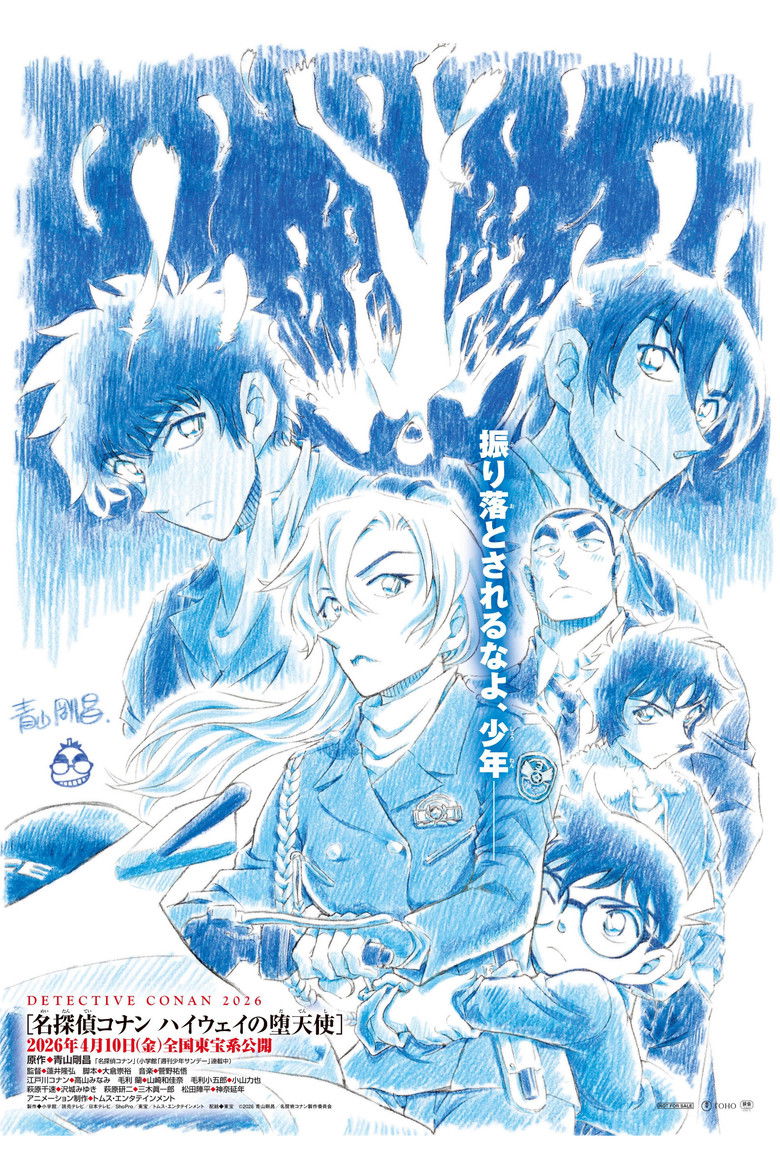
Let me think carefully about Hagiwara Chihaya — officer of the Kanagawa Prefectural Police Traffic Unit, expert motorcycle rider, and the woman Ran once described as “the wind goddess.” The phrase “once saw” in Ran’s memory is not accidental. Chihaya appears for the first time in this film, but she already exists in Ran’s past. That gap — between Ran’s old memory and our first meeting with Chihaya — creates a narrative depth before the story has even begun. We are arriving at a relationship already in progress, a history we don’t yet have access to. When will that crossing be explained? Under what circumstances did Ran encounter this woman? That single fact already functions as an emotional foreshadow.
Introducing new characters into a franchise at the 29th installment is a genuinely difficult task. The established cast, the long-running emotional arcs, the fan investment in existing relationships — all of these create gravitational pull that new characters must overcome without disrupting. Chihaya’s design addresses this challenge intelligently. Her professional context (traffic enforcement, a domain that doesn’t directly overlap with the existing detective cases) and her medium (the motorcycle, which carries different physical and symbolic associations than a gun or a deduction) give her a distinctive physicality. She is a professional in a mode entirely different from anyone else in the ensemble. Not Haibara, not Sera, not Hattori — she arrives with her own gravity.
The script must answer why Chihaya is pursuing Lucifer and what that pursuit has cost her. A good Conan film is never about the mystery alone — it’s about what the mystery reveals about the person closest to it. Chihaya’s relationship to the driver of the black bike is the emotional engine here. Sera Masumi, who appears alongside the main cast, is another element: a motorcycle enthusiast sharing the screen with a motorcycle professional creates chemistry that feels deliberately designed rather than coincidental.
RESONANCE — Twenty-Nine Films and Still Returning
I’ll be honest: I watch every theatrical Conan release. Not because I’ve followed the manga from the beginning — I left the franchise for years at a stretch. But every April I find myself back in the theater. For a long time I couldn’t articulate why. “I’m a fan” wasn’t quite accurate. “The films are reliably good” was only partially true. The closest I can come is this: the Conan films offer something harder to find in cinema than technical achievement. They offer a reliable emotional world. Conan is there. Ran is there. Kogoro is there. The mystery will be solved. The emotional stakes will be honored. This reliability is not the same as predictability — the franchise regularly surprises within its structure. It’s more like trust. The films have earned enough goodwill that walking into the theater carries a specific, quiet comfort.
What separates Angel of the Highway from that reliable baseline is Chihaya herself. The Conan films are at their best when their new characters carry genuine emotional weight that intersects with the main cast in specific, irreducible ways. Chihaya’s connection to Ran — rooted in a memory Ran has held without full context — promises exactly that intersection. When that memory is finally explained, it will reframe everything we’ve watched. That is the Conan theatrical experience at its best: retroactive emotional impact, the feeling that the film has been building toward something we didn’t fully see coming.
Every April, I’m in a dark theater. Sometimes with company, sometimes alone. And after every Conan film — even when it surprised me, even when my expectations weren’t quite met — I think: I’m glad I came. Twenty-nine years of accumulated trust is exactly that. It doesn’t guarantee perfection, but it guarantees care.
DEPTH — What “Speed” Is Really Asking
Motorcycle films carry particular philosophical weight because the motorcycle is fundamentally exposed. A car wraps its occupant in metal and glass. A bike places the rider directly in the wind, directly subject to physics, directly vulnerable. There is no mediation. And this exposure has always made motorcycle narratives feel like stories about commitment — about choosing a direction with your body and betting that your skill and your nerve will carry you through.
Lucifer, the black bike Chihaya pursues, carries a name that suggests fallen light — something that was once brilliant and has since become something else. The highway, as I’ve noted, is a space where reversal is impossible. When the film assembles these elements together — the fallen angel, the irreversible road, the rider who cannot stop — it’s making an argument about the cost of choosing a path and staying on it when the path turns dark. Chihaya’s pursuit is not merely professional. Something is driving her that goes beyond her badge and her training. The film will disclose what that something is, and when it does, the highway as setting will acquire its full meaning.
Every Conan subtitle carries a secondary meaning that only becomes visible at the end. “Angel of the Highway” will mean something different by the time the credits roll. When we understand who Lucifer’s rider is, when Chihaya’s history with that person comes to the surface, the word “angel” will shift. That is the franchise’s signature move — the retroactive reinterpretation of a title — and in 29 outings, it has not lost its power.
IMPRESSION — The Miracle of Continuation
The Conan theatrical films began in 1997. Twenty-nine years of annual releases, each maintaining enough quality and internal consistency to sustain audience loyalty, is an achievement with almost no parallel in global cinema. The franchise has outlasted its contemporary competition, survived technological shifts in animation, navigated the transition from theatrical-only to streaming ecosystems, and kept its audience growing rather than shrinking. This is structural intelligence applied consistently over decades, not luck.
What I respect most about the theatrical films is their relationship to the main series. They are not self-contained novellas that could slot anywhere in the timeline — they are aware of where the characters are emotionally in the ongoing story and they speak to that awareness even without requiring viewers to be fully current. Angel of the Highway, arriving at a point in the anime’s run when certain long-deferred revelations are approaching, will carry resonances for dedicated fans that casual viewers won’t notice. This layering is exactly right: the film works at multiple levels of investment simultaneously.
CLOSING — The Door Chihaya Opens
April 10 is a few days away. Between now and then, I’ll watch the teaser again. I’ll read the official site text more carefully than I need to. I’ll walk into the theater slightly over-prepared and probably be caught off guard anyway. That’s what these films do. The self before the film and the self after are always different. The gap between expected emotion and received emotion is part of the experience.
What kind of opening does Chihaya create in this franchise? When the identity of Lucifer’s rider is finally revealed, what will I feel? I don’t know, and the not-knowing is exactly what makes April 10 worth anticipating. If this review turns out to be wrong in its predictions, I’ll rewrite it. That’s fine too. Being wrong about a film you were anticipating is its own kind of pleasure.
TEMPERATURE — Anticipation Rating
BLAZING
Pre-release anticipation score: 92/100
The 29th theatrical film knows how to introduce novelty without breaking what it has built. Chihaya’s character design, the expressway setting, and Renyu’s proven visual instincts combine into something that feels genuinely exciting. Full review to follow post-release.
🎬 Amazonでこの映画を観る・購入する
「名探偵コナン ハイウェイの堕天使」をAmazonで探す / Detective Conan Angel of the Highway(英語)
※Amazonアソシエイトリンクを含みます
Movie data: The Movie Database (TMDb)
この記事を書いた人
零(れい)
映画・アニメ・漫画を深く観るための考察ブログ FRAME ZERO の書き手。没入と批評の両立を目指している。感動すると素直に泣くし、演出の粗も気になる。最終的にはいつも人間に興味が行き着く。


コメント