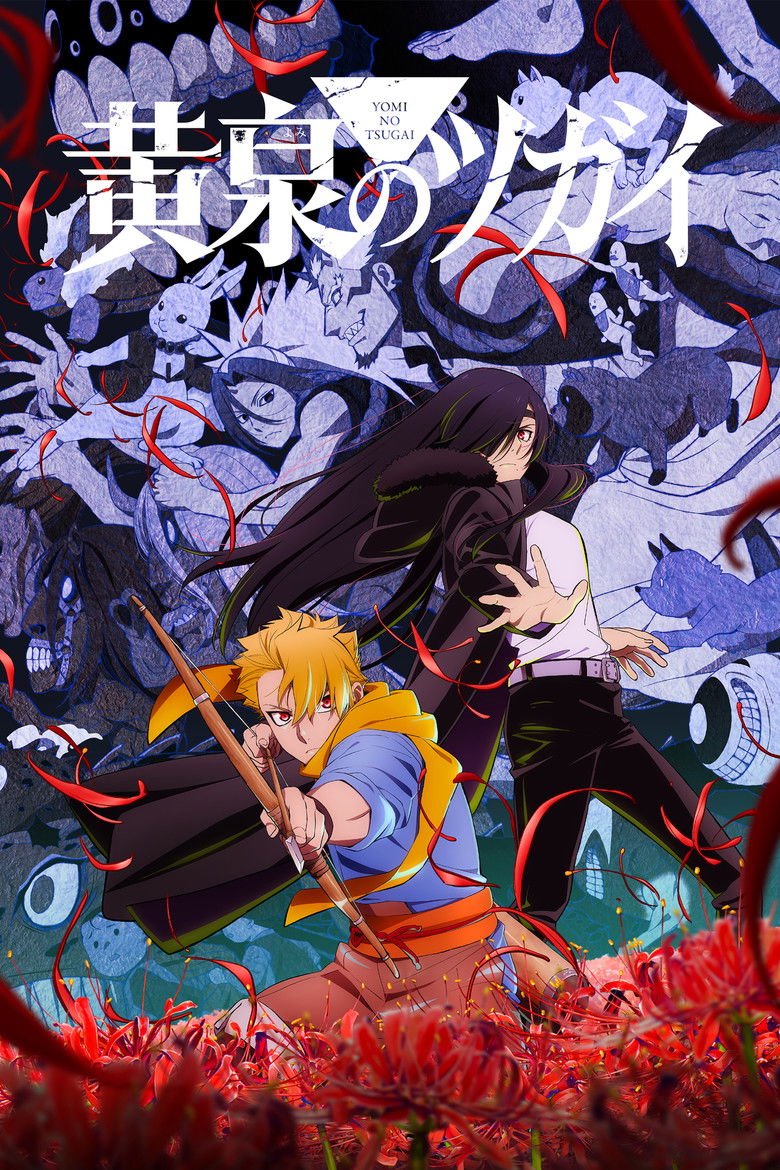
Whenever I watch a new Hiromu Arakawa adaptation, the first thing I find myself looking for is the rulebook of the world. Fullmetal Alchemist had the law of equivalent exchange. Silver Spoon had the quiet arithmetic of livestock and labor. Yomi no Tsugai, her latest work, has something similarly architectural at its core, and by the end of the first episode my strongest impulse was not to guess where the story was going, but to understand exactly how this new world operates.
This review intentionally stays inside the world-building angle. I am not going to touch plot progression, character trajectories, or fandom speculation. I want to watch how Arakawa constructs a stage, and how BONES translates that construction into animation. Both jobs are worth looking at in isolation. 黄泉のツガイ
The Pop Score
Rating based on impact and craft.
VISION ― A quietly assembled East Asian world
The first three minutes of the series refuse to cut to a close-up. We see a mountain village, a pair of twin shadows, and a landscape that absorbs the characters rather than foregrounding them. This restraint is already a world-building statement: the setting is allowed to exist before the people do. In the manga, Arakawa favors wide panels for the same reason, and the animation team has found a layout-based equivalent for that instinct. Mickey 17
The color grading is equally disciplined. Daytime scenes sit in a desaturated palette of earth and green, while nighttime pulls the black backwards and lets a single strand of violet come forward. This split is not decoration. It is the visual promise of the twins being framed, later in the narrative, as beings who separate day from night. BONES entrusts exposition to color temperature, something Fullmetal Alchemist Brotherhood did with its alchemical transmutation circles and that feels quietly inherited here.
From an art history standpoint, the village architecture does not read as the folkloric, yokai-adjacent landscape of Shigeru Mizuki. It reads closer to the ancient Japan of Ryoko Yamagishi’s Hi Izuru Tokoro no Tenshi: a historical space that is East Asian but refuses to be pinned to a specific century. That floating quality is, I think, essential to how the world of Yomi no Tsugai works.
EXECUTION ― The discipline of not explaining
Out of twenty minutes of runtime, perhaps two are spent on direct exposition. The nature of demons, the architecture of the paired beings called Tsugai, the cosmic role of the twins: all of these are sketched with a single line of narration and a single diagram, and then the story moves on. The rest of the episode is devoted to showing how Yuru and Asa actually lived before the inciting event.
This allocation of screen time is faithful to Arakawa’s gift for withholding. Fullmetal Alchemist gave us almost nothing about alchemy in its opening chapters. The rules arrived as case studies, not as lectures, and the reader assembled them from use. BONES understands this. The viewer walks away from episode one knowing less than they expected to know, and somehow more reassured than confused. That strange combination is the hallmark of a writer who trusts the reader.
The directorial choice I want to flag is the moment the twins are separated. A lesser production would deploy slow motion and a swelling score. This adaptation instead processes the separation at real-time speed, as if it were a natural phenomenon rather than a tragic event. By refusing to romanticize the rupture, the staging places the viewer alongside an impersonal cosmic law, which is exactly where Arakawa wants us.
RESONANCE ― The pleasure of being handed a map
I am the kind of viewer who gets more excited when a show hands me a map than when it hands me a climax. Yomi no Tsugai’s first episode is calibrated for that exact pleasure. The open questions are sharply drawn without yet being answered. How do demons actually obey their handlers? Are there exceptions to the Tsugai pairing rule? Has there ever been another child of separation besides these twins? None of these are resolved, but the shape of each question is clean.
That said, there is one moment where the show allows itself to be warm rather than architectural. A village elder speaks to the twins, and the voice acting lets the elder’s breath crack just slightly at the right syllable. It is the only emotionally forward beat in the whole episode, and it works because it has earned its placement. I realized, at that moment, that I was ready to trust this show with my attention for the whole cour.
DEPTH ― Boundaries, not dualities
The deepest layer of Yomi no Tsugai’s worldbuilding is not yin and yang. It is the question of boundaries themselves. Day and night, living and dead, brother and sister, human and demon: these oppositions in the show are not symmetric. The act of drawing a boundary between them is where the drama actually lives.
If yin-yang is a circle of balance, Yomi no Tsugai is a work that asks where the line should be redrawn. This resonates with East Asian folklore traditions that treat boundary spaces as sacred: torii, dosojin, village borders, bridges, mountain passes. The folklorist Shinobu Orikuchi’s concept of the marebito — a being that crosses from the other side — feels like an ancestor of what the show’s demons seem to be. None of this is necessary to enjoy the story, but knowing it adds a floor underneath the architecture.
IMPRESSION ― A worldbuilder still willing to start from zero
After the first episode I found myself quietly moved, not by any specific scene, but by the realization that Arakawa, fifteen plus years into her career, still has the stamina to build a new world from scratch. Many authors rely on sequels, reissues, or adjacent spin-offs. Arakawa has instead moved from Fullmetal Alchemist to Silver Spoon to Arslan Senki to Yomi no Tsugai, each time rebuilding the setting from the ground up.
BONES is meeting her with the same stamina. After Fullmetal Alchemist Brotherhood, the studio took on My Hero Academia and Mob Psycho 100, each with a distinct register. For Yomi no Tsugai they have chosen a quiet, restrained tone that is almost the opposite of the heat they bring to My Hero Academia. That range is what makes BONES, at its best, one of the few studios that adapts to source material rather than imposing a house style.
CLOSING ― For viewers who want to learn a world
Yomi no Tsugai rewards the kind of viewer who is more curious about how a world works than about where a plot is going. That is why I have avoided any discussion of characters or story arcs in this piece. Those articles will get written in their own time. What I wanted, right after the first episode, was a text that honored how carefully the show lays its foundation.
If you love Fullmetal Alchemist, if you are interested in BONES as an authorial presence, or if you simply enjoy reading stories through their rulebooks, this is a show to commit to early. Among the sixty-plus titles in the Spring 2026 anime cour, I would rank Yomi no Tsugai as the most architecturally trustworthy pilot I have seen so far.
A brief catalogue of Arakawa’s career-long worldbuilding may be useful for context. Fullmetal Alchemist: alchemy and equivalent exchange. Silver Spoon: the quiet arithmetic of livestock farming. The Heroic Legend of Arslan (manga version): a medieval Persian theater of conquest and abolition. And now Yomi no Tsugai: boundary mythology and paired supernatural structures. Across all four, the constant is that the law precedes the character. Characters who break the law are punished; characters who work within it are tested. That severity is both the source of narrative tension and the reader’s ground for trust.
One further detail deserves mention. The ground of the village itself feels tactile. You can almost sense whether the dirt under a character’s foot is dry or damp, whether it would hold a footprint or let it blow away. This level of composite and background painting is unusual for weekly anime. Yomi no Tsugai’s world does not float. It has roots in the ground. That physical credibility raises the architecture of the setting another notch.
I also want to point to the linguistic design of the title. Tsugai refers to a mated pair in biological Japanese, a term for the coupling of male and female animals. Arakawa strips the biological sense and refits it as a supernatural pairing mechanism. The duality of biological coupling and mythic coupling collapses into one word. This naming precision alone reveals a world built at the level of language, not just at the level of image.
TEMPERATURE ― ◎ Heat
The temperature setting is unambiguously ◎. The world exceeded what I had hoped for in terms of construction, and the BONES adaptation is visibly trustworthy. By the end of episode one, my worry that Arakawa’s new project might be average was already gone, and I suspect the show’s care for its own rules will remain intact as the plot begins to move.
この記事を書いた人
零(れい)
映画・アニメ・漫画を深く観るための考察ブログ FRAME ZERO の書き手。没入と批評の両立を目指している。感動すると素直に泣くし、演出の粗も気になる。最終的にはいつも人間に興味が行き着く。

コメント