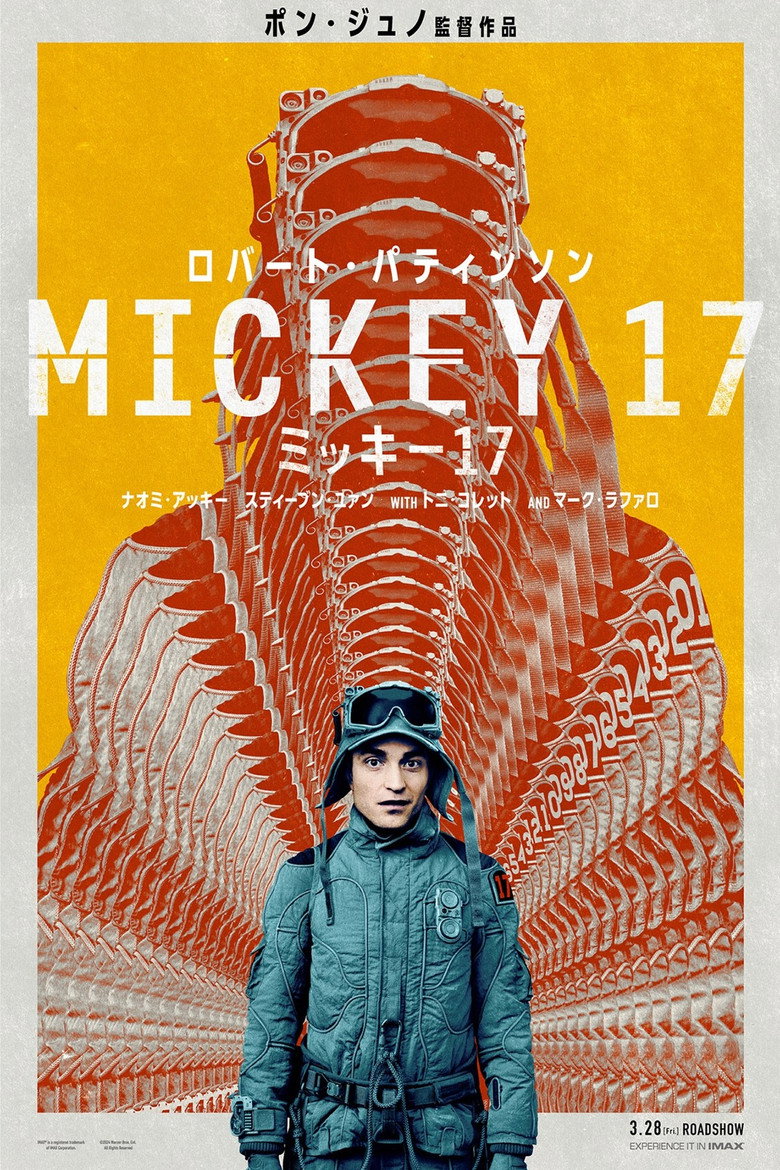
Whenever Bong Joon-ho releases an English-language feature after Parasite, my first anxiety is always about translation loss. Snowpiercer and Okja are both good films, but the temperature of the humor felt slightly off compared to the work he shot in Korean. The social ground under the jokes seemed flattened for an English-speaking audience, and that flatness was the cost of crossing the language border.
Having watched Mickey 17, I am a little relieved. It is not a complete success, but it is a clear confirmation that Bong is still, even inside a mainstream English-language production, digging at what I want to call the class skeleton of his cinema. This review is an auteur study, placing Mickey 17 in the arc of his career rather than treating it as a standalone SF spectacle.
The Pop Score
Rating based on impact and craft.
- VISION ― Old metal in the future, and a 1970s paperback texture
- EXECUTION ― Repetition and the heaviness of bodies
- RESONANCE ― Less visceral than Parasite, but thought-provoking
- DEPTH ― Digging for the class skeleton in English
- IMPRESSION ― A second pass, even in memory, reshapes the film
- CLOSING ― For viewers who want to keep following Bong
- TEMPERATURE ― ○ Favorable
VISION ― Old metal in the future, and a 1970s paperback texture
The production design of Mickey 17 is intentionally old-fashioned. The colonial ship is not glossy hi-tech. It is a world of dull metals, exposed piping, and working surfaces that look used. This texture is adjacent to Snowpiercer’s train interiors, and if you trace it further back, it reconnects to the aesthetic of 1970s science-fiction paperback covers: the John Harris and Chris Foss lineage, where space still smelled of oil and copper.
From an art-history standpoint, this is not just retrofuturist indulgence. It is a disciplined design choice for a class film. A clean shiny future hides inequality, because everyone’s workplace looks similar. A dirty used future makes it immediately obvious who does what work where. Snowpiercer worked this by arranging class horizontally along the length of a train. Mickey 17 rearranges the same logic vertically inside a ship, using pipe routing and lighting temperature to separate labor zones from command zones. The result is not merely good design. It is an auteur fingerprint — a quality it shares with the deliberate world-building in Hiromu Arakawa’s Yomi no Tsugai, where visual design is equally inseparable from authorial intent.
EXECUTION ― Repetition and the heaviness of bodies
The premise of Mickey dying repeatedly and being reprinted is not unusual as science-fiction conceits go. Moon and Edge of Tomorrow both work a similar mechanism. What Bong brings to this kind of material is his refusal to treat repetition as parody. There are jokes about the cloning cycle, but the humor leaks out of accumulated bodily weight rather than out of the high concept.
In Memories of Murder, Bong held the camera obstinately on a suspect tied to an interrogation chair. In The Host, he lingered on the monster hiding under a bridge far longer than any action film usually would. His cinema has always found pleasure in the stubborn physicality of bodies and in the weight of repetition. Mickey 17 belongs in that lineage. Robert Pattinson, playing the seventeenth iteration of Mickey, visibly carries the fatigue of the previous sixteen in his posture, and the direction insists on framing that exhaustion rather than glossing it. This is what gives the film its peculiar rhythm of unboring boredom.
A structural observation about the screenplay is also warranted. The repeating-death mechanism makes linear progression difficult. Bong turns this limitation into a feature by suggesting that residual memory from previous deaths bleeds into each new instantiation. Mickey number seventeen is more cautious than Mickey number one, slower to commit, and paradoxically better at dying. None of this is explained through dialogue. It is communicated entirely through Pattinson’s choices and the editing rhythm. Dialogue-lean storytelling has been a constant across Bong’s career, and Mickey 17 obeys the same principle.
The planet surface also deserves mention. The colonial terrain is rendered in a deliberate palette of brown and grey, purged of any Earth-like natural beauty. This tells the viewer, before any character says it, that the planet holds no future worth wanting. The managerial class and the labor class are looking at the same ground, but the color design has already split them: one sees a project, the other sees pointless dirt. In Bong’s cinema, landscape has never been mere background. It has always functioned as a physical expression of class, and the planet surface in Mickey 17 is the latest entry in that series.
RESONANCE ― Less visceral than Parasite, but thought-provoking
My emotional response did not reach the peak of Parasite. I want to be honest about that. Parasite had a sustained squeeze, like climbing one step at a time up from a basement. Mickey 17 does not have that. The genre filter of SF puts a little extra distance between viewer and character, and the bodies of English-language performers do not carry the same humidity as the Korean class reality that Parasite was saturated with. Both effects are natural costs of the genre and language shift.
What the film does instead is move my thinking. During a quiet moment between Mickey’s seventeenth death and eighteenth instantiation, I caught myself asking for the first time what Bong actually believes in at the end of the day. My tentative answer is that he does not believe in the triumph of class struggle. He believes, more modestly and more stubbornly, in the worker’s body reclaiming a piece of its dignity. That the film handed me this question is, on its own, part of its achievement.
A note on Pattinson’s performance is warranted. Since The Batman, Pattinson has consistently chosen roles that make bodily fatigue visible. In Mickey 17, playing the seventeenth incarnation, he skips the first ten iterations and presents instead a human who starts already tired, already resigned, and never once explains this through dialogue. That is why Bong cast him. For a director whose entire method is staging class through bodies, an actor who can hold weariness silently in his posture is the ideal instrument.
DEPTH ― Digging for the class skeleton in English
The core of Bong’s authorial identity is showing class through bodies and spaces, not through argument. Memories of Murder exposed hierarchy via a detective’s interrogation tactics. The Host trapped a family between a monster and an administrative bureaucracy. Snowpiercer laid class along a train. Parasite stacked class vertically across a basement, a semi-basement, a ground floor, and a hillside mansion. Bong’s method is always spatial and physical.
What Mickey 17 proves is that this method survives translation. Even in an English-language SF blockbuster, Bong keeps staging class through space and body. The Korean humidity of his best work is not fully recovered here, but the loss is smaller than in Snowpiercer or Okja. The filmmaker has adapted to the trial of translation without giving up his subject. That is the serious craft story of this release. For a broader look at how IP is moving across media formats in 2026, see our analysis of the live-action-to-anime adaptation boom.
IMPRESSION ― A second pass, even in memory, reshapes the film
Mickey 17 is the kind of film that rewards a second sitting, and sometimes a mental replay is enough to do the work. On first viewing, the novelty of Pattinson playing seventeen variants and the retrofuturist visuals pull attention away from the class skeleton, which slips by quietly. Later, when the memory has cooled, the skeleton becomes clearer and the film seems sturdier. Most of Bong’s films work this way. Memories of Murder and The Host both reveal their architecture more cleanly on the second look.
CLOSING ― For viewers who want to keep following Bong
If you are hoping for a linear continuation of the Parasite sensation, Mickey 17 will feel slightly oblique. If you have been following Bong’s entire career, the film instead functions as confirmation that a class-cinema director has not lost his subject inside a big English-language production. I would recommend it to viewers who liked Snowpiercer and Okja, to anyone who wants to see social critique smuggled into SF spectacle (readers interested in how Japanese IP is crossing media borders may also enjoy our look at Shonen Jump live-action adaptations), and to anyone still tracking Bong as a career-long project worth watching.
A final longitudinal note. Running through Bong’s career chronologically, a single through-line emerges: the weight of bodies. Barking Dogs Never Bite begins with a man chasing a dog through an apartment complex. Memories of Murder holds the camera on a suspect’s flesh as interrogation turns ritual. The Host lets a family’s physical clumsiness drive its monster-movie structure. Snowpiercer fills a train with bodies pressing forward. In each case, Bong stages class not through argument but through mass, friction, and fatigue. Mickey 17 is the newest entry in this list, and knowing the lineage makes the film’s quieter achievement considerably more visible.
TEMPERATURE ― ○ Favorable
The temperature setting is ○. The Parasite-level heat is not here, but the three components of my expectation — continuity of authorial identity across the language border, class-film precision, and coherent SF blockbuster storytelling — all come in at or slightly above what I was hoping for. The warmth of this rating is the quiet satisfaction of confirming, after the credits, that this particular filmmaker is still digging into his own seam.
この記事を書いた人
零(れい)
映画・アニメ・漫画を深く観るための考察ブログ FRAME ZERO の書き手。没入と批評の両立を目指している。感動すると素直に泣くし、演出の粗も気になる。最終的にはいつも人間に興味が行き着く。


コメント