- VISION — Mapping What Is Actually Happening on the Floor in 2026
- EXECUTION — Between “Already Being Used” and “Should Be Used”
- RESONANCE — The Complicated Temperature I Hear From Insiders
- DEPTH — How the Word “Tool” Is Being Used
- IMPRESSION — The Posture the 2026 Industry Should Take
- CLOSING — How I, As a Viewer, Want to Approach This
- TEMPERATURE — Rating
VISION — Mapping What Is Actually Happening on the Floor in 2026
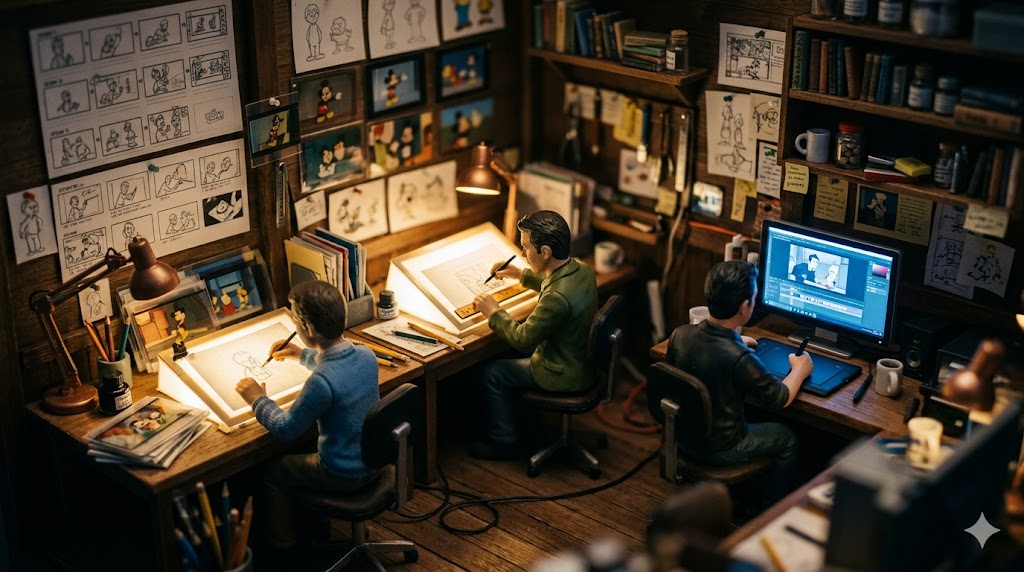
In April 2026, I want to take stock of where AI use in anime production currently stands. This piece is not a review of a specific work. It is an attempt to organize a complex industry situation as a record of where things are and where they are pulling. The term “AI” entered the production discourse in earnest a few years ago, and since then a series of titles have made specific implementations public. Pushback, on-floor confusion, and labor-organizing developments overseas have layered on top of one another, and I think it is worth pausing to draw the lines.
What became unmistakable across 2025 and 2026 is that “AI use” as a phrase covers an absurdly broad range. Coloring assistance for backgrounds, automatic in-betweening, initial character design sketches, structural review of screenplays, voice-actor guide tracks generated by voice cloning — all of these are reported under the same umbrella. On the floor they are not the same thing. Coloring assistance reads as an extension of conventional software; voice cloning belongs to a categorically different ethical zone.
The Pop Score
Rating based on impact and craft.
This column tries to draw the boundary line of “AI as tool” along both practical and ethical axes. My own background is fine art education, and my direct experience of animation production is limited, but the conversations I hear from peers in the industry have given me a tactile sense of the moment that I think is worth recording.
EXECUTION — Between “Already Being Used” and “Should Be Used”
Listing AI applications in production by their depth of impact, in ascending order:
First, AI use to generate reference images. At the storyboard stage, an artist generates an AI image to communicate “I want a composition like this” to the team, and the actual frame is hand-drawn from there. No AI artifact ends up in the final work. This is broadly the digital descendant of cutting reference images out of magazines, which storyboard artists have done since the 1990s. The ethical zone is narrow.
Second, coloring assistance. AI helps with separation and intermediate color generation. The floor generally welcomes this as efficiency improvement, although the question of whether the underlying model was trained on uncleared third-party work remains open and serious.
Third, automated in-betweening. Replacing a step that animators have traditionally performed. Quality concerns and labor concerns both apply. This has the potential to alter the in-betweener job category itself, and overseas anime industries have already raised it as a labor-negotiation topic.
Fourth, character design suggestions. This enters the territory of authorial style and demands the greatest caution. How much do AI suggestions respect the creator’s instincts, and how much do they unconsciously narrow the creator’s option space? These are the relevant questions.
Fifth, structural review of scripts — pointing out weaknesses in screenplay structure. Functionally a partial replacement of editorial roles. As long as final judgments remain human, the impact is bounded.
Sixth, voice cloning. Currently the most cautiously handled zone. Floor implementations are conservative. Using clones as temporary guide tracks is ethically very different from incorporating them into the released product.
RESONANCE — The Complicated Temperature I Hear From Insiders
Friends from art school have ended up in animation production, and what I hear from them is more complex than the binary discourse online would suggest. Most floor-level workers I know are not categorically opposed to AI use. Their concerns are about “how it is used” and “who controls the decision.”
An in-betweener friend tells me, “If AI handles the simple in-betweens, I can spend more time on the expressive work.” Another, an episode director, tells me, “If a producer-level person sees an AI-generated reference image and decides ‘this is fine,’ the floor’s authorial choices get overridden.” These are not technical questions. They are questions about the human judgment that surrounds the technology.
The most striking thing I have heard came from a former art-school classmate who now works in background art: “When AI gave me a rough draft, my first reaction was relief. Then I realized I no longer knew whether to call a frame composed of lines that didn’t come out of my own hand my own work.” This is not a technical statement. It is a question about authorial identity. AI shakes the artist’s self-conception, and that disturbance is happening in parallel with the labor-structure problem, on a separate but linked layer.
DEPTH — How the Word “Tool” Is Being Used
The phrase “AI is just a tool” recurs across the discourse. It carries two contradictory implications. One is positive — “so use it freely, it is just a convenient instrument.” The other is cautionary — “so handle it with care, understand the nature of the instrument before using it.” The same word “tool” leads to opposite conclusions depending on context.
What I want to question is the limit of the word “tool” itself. Pencils and brushes follow the will of the person holding them. AI does not. AI carries the will of others inside its training data, and those judgments leak into the generated outputs. When we say “this is just a tool” while using AI, we are unconsciously importing the judgments of the data providers into the work. The relation is structurally different from the relation a hand has to a brush.
Historically, every new technology has forced artists to redefine their relation to it. Photography freed painting from the role of “recording reality.” Cinema let photography find its specific identity in “freezing the moment.” CG redrew the boundary between animation and live action. AI will likewise produce new role divisions in animation production. The question is who decides those divisions, and through what process.
IMPRESSION — The Posture the 2026 Industry Should Take
The industry’s primary need is not a yes-or-no on AI use. It is transparency around AI use. For what purpose, in what step, and to what degree was AI used in this work — if every released production answered these questions, viewers could choose their own distance. Notes in credits, statements on official sites, common formats across the industry — these are the first steps that would clean up the current confusion.
The second need is structural protection of floor-level labor. When jobs are eliminated by AI, who in the industry supports those workers’ lives and their transitions to next careers? Overseas labor groups have already made this a negotiation point. Japanese animation has historically weak collective bargaining structures, and the systemic response is lagging. This is separate from any individual work’s quality. It is about the sustainability of the industry as a whole.
CLOSING — How I, As a Viewer, Want to Approach This
As a viewer writing this column, I am pressed every week to make my own judgments about AI. When I watch a new anime, do I attempt to register how AI was used — or not? Does that registering change my evaluative axis — or not? These are individual choices. Their answers are not fixed, especially in this period, where technology, floor practice, and ethics are all in motion simultaneously. I want to grant myself, and grant others, the freedom to suspend judgment in cases where the field is genuinely unsettled.
At the same time, I have power as a viewer. The power is to keep recording the works that move me. The weekly pieces I write at FRAME ZERO are an accumulation of those moments of being moved. Whether or not AI is involved, a work that moves me is a work that means something to me. Maintaining that personal evaluative axis is, I think, the minimum responsibility I can take as a viewer in the current state of the industry.
TEMPERATURE — Rating
MIXED
Score: 65/100 (industry assessment)
As of spring 2026, AI in anime production is in a transitional state where confusion and progress are happening simultaneously. Whether the industry can move organizationally on the two axes of transparency and labor protection will determine the next several years. As a viewer, I can only suspend judgment where the field is unsettled and keep recording the works that genuinely move me.
この記事を書いた人
零(れい)
映画・アニメ・漫画を深く観るための考察ブログ FRAME ZERO の書き手。没入と批評の両立を目指している。感動すると素直に泣くし、演出の粗も気になる。最終的にはいつも人間に興味が行き着く。


コメント