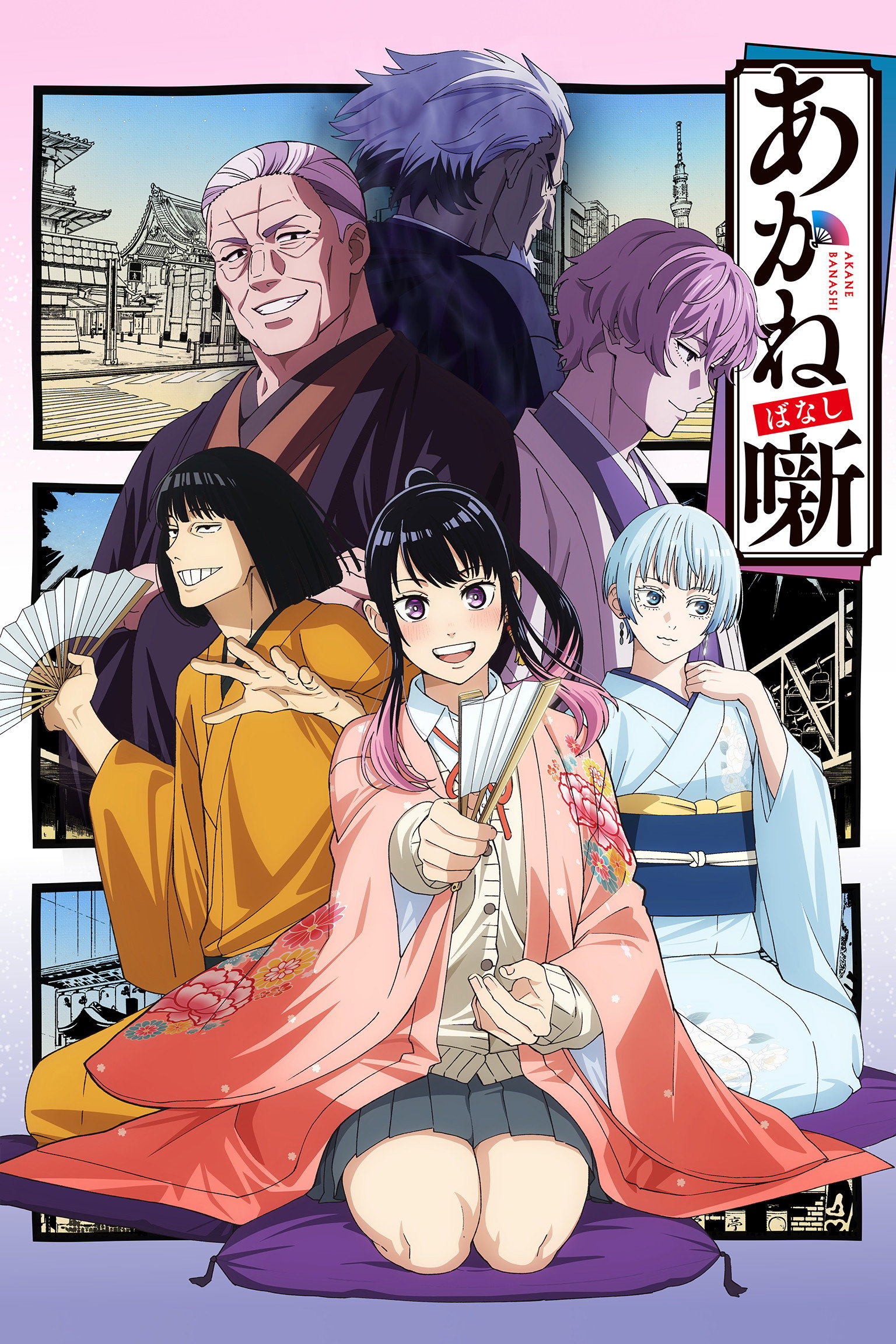
VISION — The Strange Heat of the Rakugo Stage
Watching rakugo in animated form is, at first, a curious experience. Rakugo is fundamentally a solo performance art: one person, one stage, one fan, one cloth. No sets, no special effects, no supporting cast. The entire narrative exists through a single body’s transformation into multiple characters. And yet when I watched the first episode of Akane-banashi, I couldn’t look away. The atmosphere of the high seat — the elevated stage where a rakugo performer sits — came through the screen in a way I hadn’t expected animation could achieve. The spotlight on the performer, the dim surrounding space, the invisible tension between stage and audience: the show found a way to render all of this.
Akane-banashi is a Spring 2026 anime adaptation of a manga about rakugo — the traditional Japanese comic storytelling art. The protagonist, Aragawa Akane, enters the world of rakugo to avenge her father Issho, a performer who was forced out of the profession by Shiguma, the master at the top of their rakugo school. The story follows Akane’s ascent through the competitive world of the rakugo hall, structured around the explicit goal of someday facing Shiguma. The grammar is familiar: sports manga applied to performing arts, with all the attendant elements — clear objectives, training sequences, rivals, walls that seem impossible to break. But rakugo introduces a friction that sports narratives don’t usually face. In sports, strength can be objectified through scores and outcomes. In rakugo, the only measure of skill is whether the audience laughs. That subjectivity complicates the story in productive ways.
The Pop Score
Rating based on impact and craft.
The animation handles rakugo performance sequences with real care. When Akane performs, her facial expressions shift rapidly, representing multiple characters through micro-changes in posture and tone. The visual choice to show a single character embodying a cast of others actually illuminates what rakugo does: it makes the audience’s imagination do the work, and animation can represent what that imagination produces. The medium and the material turn out to be a better match than I expected.
EXECUTION — Sports Manga Logic in a Non-Sport World
The script of Akane-banashi operates on shonen manga principles: a protagonist with a clear objective, cycles of training and setback and breakthrough, a mentor-student dynamic with its accompanying tensions, rivals who illuminate different aspects of the protagonist’s character. These are the same tools used by Haikyu!! or Demon Slayer. What distinguishes Akane-banashi is the specific resistance that rakugo provides to this framework. Sports competition produces objective outcomes. Rakugo does not. Whether a performance is “good” exists only in the response of an audience on a given night, in a given room, with a given set of expectations. That context-dependence gives the narrative a philosophical weight beneath its kinetic surface.
The mystery at the story’s foundation — why did Shiguma force Issho out? — is where this weight is concentrated. At the end of the first episode, Shiguma reads as a straightforward antagonist, an authority figure wielding his power arbitrarily against a performer who threatens him. But rakugo is a tradition of mentorship and inheritance, and no master forces out a student without reasons that feel, to that master, substantive. As Akane progresses, I expect Shiguma’s image to become more complex — not exonerated, perhaps, but understood. The question of what Issho’s rakugo lacked (or had in excess) will be central to that complexity.
The voice performance demands in this show are exceptional. Rakugo scenes require the cast to perform “performing rakugo” — to voice a character voicing other characters — and the first episode demonstrated that the voice direction has risen to that challenge. The distinction between Akane’s ordinary speech and her performance voice is already audible in episode one, which is a meaningful achievement.
RESONANCE — “For My Father” as Emotional Foundation
One reason Akane-banashi pulls me in quickly is the simplicity of its emotional engine. Akane’s motivation reduces to a single, universally legible point: my father was wronged, and I intend to answer that wrong. Parental love combined with outrage at injustice — this is not a complex psychology, but it’s a powerful one. It doesn’t require explanation or setup. It arrives fully formed and immediately legible.
What I’m watching for, going forward, is the moment the story separates Akane’s relationship to her father from her relationship to rakugo itself. In sports narratives, the turn from “I’m doing this for someone else” to “I’m doing this because I love it” is typically the story’s pivotal transformation. Akane will presumably have this turn — a moment when performing rakugo ceases to be an instrument of filial duty and becomes something she does because the art itself demands it. When that moment arrives, the show’s emotional register will expand. I’m waiting for it.
The theme of inheritance runs under everything in this story. Rakugo passes from master to student, from father to child. Exact imitation is not inheritance — inheritance requires finding the place where the received tradition becomes one’s own voice. Akane knows her father’s rakugo. The question is when she’ll discover her own.
DEPTH — What Rakugo Asks About Art Itself
Rakugo is a strange art form. The repertoire is fixed — performers return to the same stories for decades. A performer might do Toki-soba (“Timing the Buckwheat Noodles”) a thousand times in their career. Yet audiences experience something different each time. The performer’s age, the mood of the room, the season, the accumulated weight of past performances — all of these variables act on an unchanging text and produce something new. This is “change within repetition,” and it’s the art form’s core paradox.
Akane-banashi embeds this paradox in its structure. Every time Akane performs the same piece, it will be different — because she is different. Her growth as a performer will be marked by what changes in her rendering of fixed material. Shiguma as “guardian of the art” positions himself as the one who determines what those changes should and shouldn’t include. Whether his judgment about Issho was correct — whether there is even a “correct” judgment in such matters — is the question the story will have to answer. Embedded in a shonen framework is a genuinely difficult question about authority and tradition in the arts.
IMPRESSION — Its Position in Spring 2026
Spring 2026 is a crowded season for anime — multiple continuing series, multiple high-profile sequels. In this environment, Akane-banashi occupies a distinctive position by virtue of its subject matter. Rakugo doesn’t compete with fantasy or sports or romance for audience attention; it offers something that isn’t available elsewhere in the current lineup. The first episode was designed with this accessibility in mind, taking care to introduce rakugo’s pleasures to viewers who have no prior relationship with the art form while keeping the emotional narrative in motion. That double work succeeded.
The ongoing challenge will be the rakugo pieces themselves. Each episode’s performance sequence must communicate to uninitiated viewers why this particular piece is funny, moving, or technically impressive — and must do so without slowing the narrative. That’s a sustained, difficult task. If the show meets it, Akane-banashi could have a genuinely long run.
CLOSING — The Voice That Reaches
After the first episode, I found myself thinking about the stillness before a laugh. The compression of expectation just before an audience releases. Akane-banashi is attempting to render that compression in animated form, and it has a better chance of succeeding than I initially thought it would. Whether it ultimately does — whether the show sustains the quality of its opening across a full season — I don’t yet know. But the direction is right, and the material is worth the attempt. I’ll keep watching to hear what Akane’s voice sounds like when she finally stands before Shiguma.
TEMPERATURE — Rating
WARM
Score: 79/100 (Episode 1 evaluation)
An intelligent choice of subject matter, handled carefully. The sports manga framework applied to performing arts produces productive friction, and Akane’s simple motivation reads as a strength rather than a limitation. Much depends on how the show handles individual rakugo performance sequences going forward.
この記事を書いた人
零(れい)
映画・アニメ・漫画を深く観るための考察ブログ FRAME ZERO の書き手。没入と批評の両立を目指している。感動すると素直に泣くし、演出の粗も気になる。最終的にはいつも人間に興味が行き着く。

コメント